
How did the French Revolution begin? With the fall of the Bastille. Similarly, how did the American Revolution begin? With shots fired at Lexington and Concord.
Those are the stock answers, but neither marked the first act of open defiance against the crown. Americans might point to the Boston Tea Party, the Boston Massacre, or the Stamp Act riots. Frenchmen may say the erosion of royal authority that overthrew France’s social order began with the Estates General in 1789 — but before that, the first event to both rock the foundation of the monarchy and display open defiance of royal authority was the “Diamond Necklace Affair,” also known as the “Affair of the Queen’s Necklace.”
This article retells the story of the Diamond Necklace Affair — one of the most notorious public scandals in history. It involved great fortunes made and lost, avarice, mystery, and intrigue. It pitted great forces in French society against each other, and in the end severely damaged the monarchy, and destroyed for all time the reputation of the second-highest public figure in France. The story begins with three players, the first of whom is that famous public figure: the Queen of France, Marie Antoinette.
The Queen

Élisabeth Louise Vigée Le Brun, 1783. Oil on canvas. Private collection (Wolfgarten Castle, Hesse). Public domain, via Wikimedia Commons.
Marie Antoinette was an Austrian princess when she came to France at age fifteen, in 1770, to marry the Crown Prince. She and her husband Louis XVI were still teenagers when they ascended the throne in 1774. Unlike her shy, awkward husband, Marie Antoinette was admired for her legendary beauty, grace, and elegance, and her tastes set fashion trends across Europe. She took pride in her appearance and in her ancestry as a princess of the House of Habsburg, the oldest royal house in Europe. Her arrogance bred resentment among the old nobility of France — a country that had been at war with Austria for much of the eighteenth century. Marie Antoinette also attracted gossip for her inability to become pregnant (due to Louis’s impotence) and produce an heir to the throne, for her youthful disregard of court etiquette, and for her frivolous and costly lifestyle. This lifestyle included gambling, masked balls, late-night rendezvous, and rumours of numerous love affairs with both men and women. By 1785, an underground literature existed that reviled the Queen in pornographic songs, pictures, and pamphlets.

Much of Marie’s fast-and-loose behaviour in her first decade in France was a reaction to her marital frustration, but in 1778 Louis underwent an operation, and the couple at last had children. By 1785, Marie Antoinette had given birth to three children. She was maturing, and her lifestyle had grown far more settled and less extravagant. But that change was barely noticeable to the uninformed public and did little to appease those who had already developed a deep dislike for her.
The Nobleman

Against this backdrop, in 1784, enter the two key players in the story: a great nobleman and a woman swindler who dupes him. The nobleman Louis René Édouard de Rohan was a Cardinal of France and a son of one of its oldest and most celebrated noble houses. However, Rohan had a problem — he was out of favour at the French court. The Queen’s mother, Marie Thérèse, had disliked Rohan, a frivolous dandy, during his time as a diplomat in Austria. After her mother scorned him, Marie Antoinette refused to receive Rohan and had not spoken a word to him in years. For a decade, Rohan had longed to become a member of the Queen’s inner circle, with the favour and patronage such access could bring. Rohan, the dandy, was also attracted by the Queen’s beauty and fancied that, if she would only admit him to her circle, he too might partake in the amorous adventures so frequently rumoured at court.
The Swindler

The woman swindler is the Countess de Lamotte. She was a daughter of the ancient and illustrious Valois family, though the family had long since lost its resources. She was quite impoverished when she arrived in Paris, but Lamotte was also attractive and brazen in her desire to escape poverty and obtain an aristocratic life of comfort and leisure. She sought to enlist the sympathy of the royal court on behalf of a woman from one of France’s great old houses. Given to fainting spells at court, she at last received notice from Madame Élisabeth, the King’s sister, who provided her with some financial support. She also caught the eye of Cardinal Rohan, and by 1784 had become his mistress. Even though she had not succeeded in obtaining the Queen’s interest or support — and had never even met the Queen — Lamotte managed to convince Cardinal Rohan that she enjoyed Marie Antoinette’s favour. Rohan fully subscribed to the tales circulating in court circles about Marie Antoinette’s dissipation. Using her attractive looks to great effect, Lamotte spun stories that convinced Rohan she was becoming one of the Queen’s new intimate companions — just as Rohan himself hoped to become the Queen’s lover.
The Necklace

Now enters the object that everyone sought: the necklace. It was composed of 2,800 carats of diamonds. First came a choker of seventeen diamonds, each weighing five to eight carats; from that hung a three-wreathed festoon with pendants; then came the necklace proper, a double row of diamonds culminating in an eleven-carat stone; and finally, four knotted diamond tassels. It cost 1,600,000 livres — perhaps the equivalent of $100 million in today’s currency. The jeweller Charles Boehmer had commissioned the magnificent necklace for Madame du Barry. But Louis XV died, du Barry was banished from court, and Boehmer pinned his hopes on the new Queen. She modelled it before her ladies but would not purchase it, nor permit Louis to buy it as a gift for her. “Better to buy a new ship of the line than to spend such a sum on a necklace, however beautiful,” she said.
The Opportunity
Boehmer had also seen Lamotte at court. Like Rohan, the jeweller believed the rumours about Marie Antoinette and, impressed by Lamotte’s looks and convinced of her intimacy with the Queen, sought her out as an intermediary. Knowing Rohan’s keen desire to gain the Queen’s favour, Lamotte saw her opportunity: she would trade on both men’s belief in her closeness to the Queen to satisfy their desires — and enrich herself. She told the Cardinal that the Queen wished him to secretly purchase the necklace on her behalf. The Cardinal obtained the necklace from Boehmer and handed it to Madame Lamotte, expecting the Queen to pay for it. Of course, Marie Antoinette never saw the necklace. Lamotte gave the diamonds to her husband, who took them to London and sold them. She also forged letters in the Queen’s name to Rohan, attesting to her interest in the necklace, approving the plan and Lamotte’s role, and hinting that Rohan could expect a return to the Queen’s favour.
The Rendezvous
The forged letters satisfied Rohan for a time, but at Versailles, Marie Antoinette continued to ignore him as always. He wanted a real sign of her interest. And so, in the gardens of the Palais Royal in Paris, the final piece of the puzzle fell into place — in the form of a twenty-five-year-old streetwalker named Madame d’Olivia. Buxom and blonde, with an arrogant strut that caused people to call her “the Queen,” d’Olivia bore a striking resemblance to the twenty-nine-year-old Marie Antoinette. Lamotte was immediately captivated. And so, Cardinal Rohan did receive the sign of favour he had longed for — or so he thought. On a summer night in 1784, Lamotte dressed d’Olivia in a lawn gown, identical to the famous “en gaulle” portrait of Marie Antoinette then on exhibit. The veiled woman briefly met the Cardinal in the gardens of Versailles late at night, as Antoinette was rumoured to meet her lovers. The false Queen handed the Cardinal a rose. “All may be forgiven,” she whispered, then hurried away — leaving Rohan utterly convinced he had met Marie Antoinette herself.
The Confrontation
Unaware of the drama unfolding around her, Marie Antoinette was busy preparing herself for the role of the saucy barmaid Rosina in the controversial play The Marriage of Figaro. One day, during rehearsals, Boehmer’s invoice for the necklace arrived and was discarded by the Queen. Later, Boehmer came to Versailles and spoke to the Queen’s attendant, Madame Campan, seeking payment. He displayed forged letters bearing the Queen’s signature and explained how Cardinal Rohan had been involved in acquiring the necklace. At last, Marie Antoinette grasped the seriousness of the situation and summoned Boehmer to Versailles. She was furious with Rohan, as was Louis XVI. The royal couple demanded a trial. They arranged for the Cardinal’s arrest — the most public arrest imaginable — having the warrant delivered to him in the great hall of Versailles before hundreds of witnesses. He was brought before the King and Queen, who confronted him with the swindle and refused to hear his protestations of innocence and his claims that he too had been made a fool.
The Trial

The public arrest of the Cardinal of France had already caused a national sensation, and the actions of the King and Queen that followed only added fuel to the fire. That this nobleman — with whom she had not exchanged a single word in fifteen years — should dare to presume she, Marie Antoinette, had met him at a secret rendezvous was a profound insult to her name and reputation. The proud Queen demanded public vindication. The matter could have been handled quietly at court or through the Vatican. Louis’s advisors counselled caution, but the wavering King agreed to a public trial before the Parlement of Paris.
France in 1785 was unaccustomed to such public spectacles. While rumours of Marie’s errant behaviour had been prevalent in the capital, they now became a sensation across all of France. The charge against the Cardinal was lèse-majesté — an insult to the dignity of the Queen. For months, the nation was gripped by the mystery of the diamond necklace and by the endless recounting of the Queen’s reputation that had led Rohan to believe she had participated. The public was riveted by the cast of characters: the swindler Lamotte, the prostitute who had impersonated the Queen, and a $100 million necklace at stake at a time when the country faced bankruptcy. Throughout it all, Lamotte maintained that the Queen was behind everything and had the necklace.
The Verdicts
Defending the Queen’s dignity was never going to be easy. Though she never appeared in court, this case put the life and character of Marie Antoinette on trial. Many jurors could well believe, given her past spending and reputation for a loose lifestyle, that the Queen was capable of such activities, and that the Cardinal had been reasonable in his assumptions. The Cardinal struck a sympathetic figure as he pleaded his devotion to the Queen and insisted he had only sought to serve her. But this was no ordinary court — it was a court of nobles in Paris, where the Rohan family was powerful and wealthy, where many had been at odds with the King, and where even more resented the Queen. Considerable sums were also passed in bribery by the Duc d’Orléans and other disaffected noblemen. The trial ended with the Cardinal acquitted of the charge of lèse-majesté. Lamotte was found guilty of theft and imprisoned. She was also publicly flogged and branded. As she struggled against the branding iron, the poker slipped and pierced her breast. Lamotte hurled imprecations for all to hear: “It is the Queen who should be branded, not me!”
The Uproar
On the night of the verdict, against her constable’s advice, Marie Antoinette attended a charitable benefit at the Paris Opera. When the verdict — “Rohan Acquitted” — was announced, the opera house erupted in applause. The crowds then whistled and jeered at the Queen, who departed in dismay and returned to Versailles to weep with her ladies-in-waiting. Repudiation of a French sovereign by court verdict and public rebuke had never before occurred. The Revolution had begun. Within the year, Lamotte escaped to London, where she and her husband enjoyed the proceeds from the sold diamonds. She also took up the pen to spread malicious rumours about Marie Antoinette.
The Libels
Lamotte’s pamphlets — filled with new tales of the Queen’s sexual appetites and orgies at Versailles, along with alleged love letters between Rohan and the Queen — became a new sensation in France as they were smuggled in by the thousands. The court literature against Marie Antoinette, which had previously circulated mainly in the capital, had now, by virtue of the necklace case, become commonplace throughout France. The economic position of the country worsened, and King Louis — who had drawn closer to Marie in her sorrows — increasingly turned to her for advice on economic matters. The Queen’s growing role in affairs of state, combined with her national disgrace, weakened the position of Louis and the monarchy. Her very presence galvanised and emboldened the opponents of the regime.
The Revolution
Revolution might have been averted in France after the necklace case, just as it might have been averted in America after the Boston Tea Party — but a course of action had been set in motion. The monarchy had been humbled by the noblemen in court and by the people, and all of it had been done with impunity. Going forward, the opponents of the regime — first among the nobles, then later among the merchants, and finally among the peasantry — took heed and did not relent until the final violent overthrow of the French monarchy and the Terror that followed. The nobles who had sought to check Louis’s power, and others like Philippe Égalité who had resented the King, came to be caught up themselves in the whirlwind of Revolution. That Revolution would claim the lives of thousands of noblemen, including Philippe himself, and bring an end to the privileges nobles had enjoyed in France for centuries. This was not what the nobles had intended when they sought to vindicate Rohan and strike a blow against the King and Queen.
The Reversal
When Marie Antoinette learned of the necklace affair, she instinctively insisted on a public trial to avenge the offence to her honour and dignity. No one could have imagined how that act of hubris would trigger the catastrophic upheaval of Revolution in the seven years that followed. In 1786, Madame Lamotte was imprisoned and branded; Rohan was acquitted at trial but forced from his Cardinal’s post to a remote appointment. Marie Antoinette sat upon her throne — still the glamorous, powerful Queen of France — meting out punishment to those who dared transgress her honour. In seven years’ time, the Revolution would reverse the positions of all three players in this story. By 1793, Lamotte, who had escaped prison, lived in comfort in England. The fortune she and her husband had gained from the necklace was augmented by the profits from her best-selling pamphlets against the Queen — pamphlets that had made her a hero of the Revolution. By 1793, Rohan too was living in comfortable exile. In the early years of the Revolution he had returned to France in triumph and been elected to the Assembly, but seeing the violent turn of events against the nobility and clergy — including members of his own family — he fled once more to live out the remainder of his life abroad.
The World Upside Down
In the ultimate role reversal, the hunter became the prey. The year 1793 saw the final destruction of Marie Antoinette — humbled, humiliated, and at last beheaded by her own subjects. The years of Revolution had taken everything from her: her palaces, her jewels, her servants, her fine clothes, her friends, and her family. Her beauty and finery — in which she had taken such pride — and all the other trappings of her once fabulous life, were gone. In the end, Marie Antoinette was alone. She was taken from her prison cell as a poor, broken widow in rags, aged beyond her years. Now it was she who stood in the dock. She who would have to answer the charges of the Revolutionary Tribunal — including the necklace affair allegations of Madame Lamotte.
The Queen Beheaded
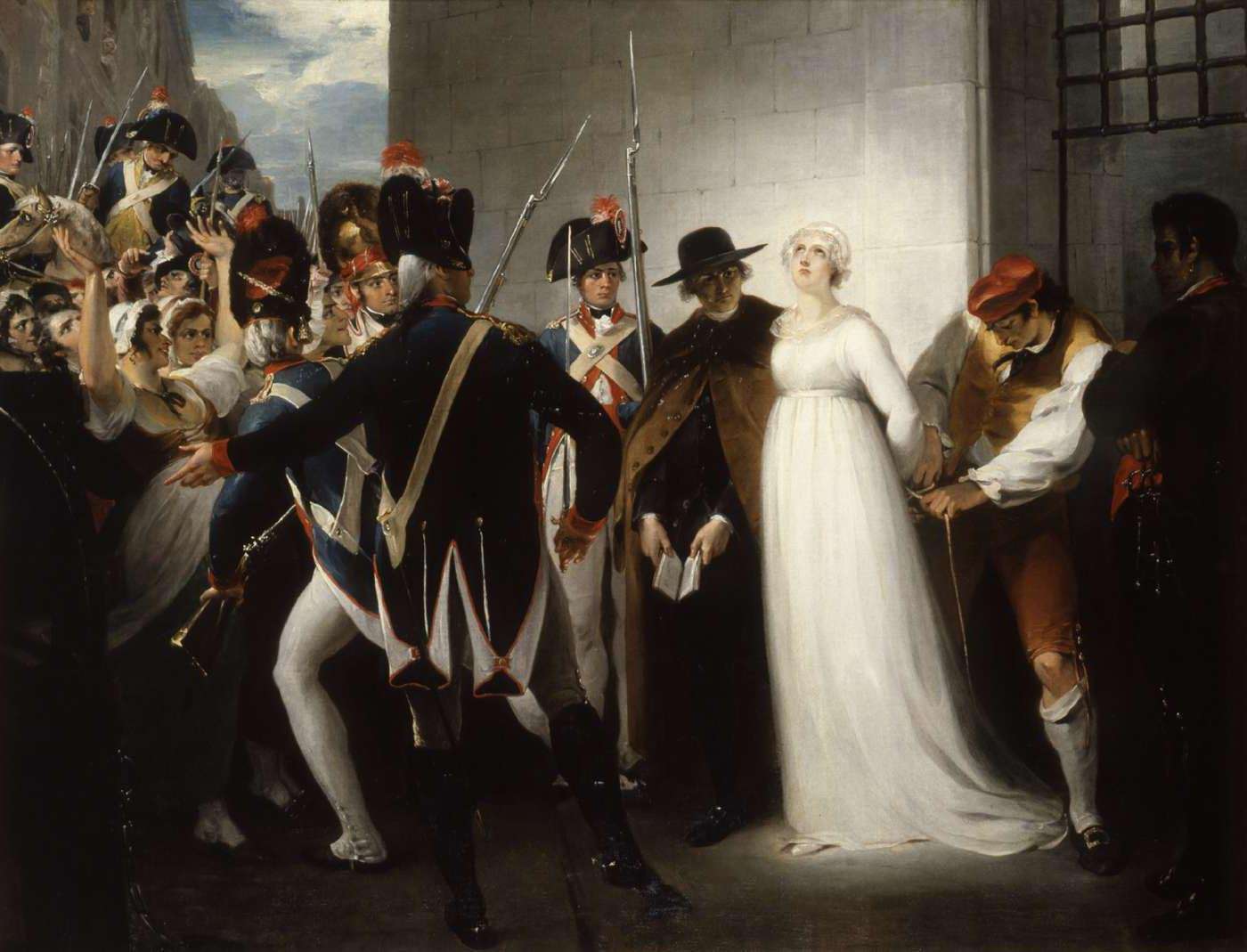
Those charges still rang in her ears amid the jeers of the crowd as Marie Antoinette rode to her appointment with Madame Guillotine. The former Queen now rode in an open cart, her hands tied behind her back, tethered like a chained animal. Lamotte must have relished the irony: seven years after she herself had been flogged, branded, and humiliated, seven years after she had sworn vengeance, it was the turn of her tormentor to face punishment. Marie Antoinette was beheaded at age thirty-seven, her head held high as the populace cheered her death. Such was the pendulum swing of the great French Revolution — first set in motion by the case of the Queen’s necklace.