

A Reputation in Shreds
- At January 14, 2008
- By Clare
- In A Reputation in Shreds, Articles


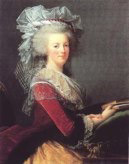
She is the queen who danced while the people starved; who spent extravagantly on clothes and jewels without a thought for her subjects’ plight. Such is the distorted but widespread view of Marie-Antoinette, Queen of France (1755-1793), wife of King Louis XVI. The recent Coppola film has further damaged the image of the much-maligned, beautiful and charming Austrian archduchess, sent to France at age fourteen to marry the fifteen-year-old Dauphin. Sadly, the picture many people now have of Marie-Antoinette is of her running through Versailles with a glass of champagne in her hand, eating bonbons all day long, and rolling in the bushes with a lover.
An article by E.M. Vidal
In reality, she was a teetotaler who ate frugally. She was notorious for her intense modesty. Even some prominent biographers, who have insisted upon the possibility of an affair with Swedish Count Axel von Fersen, have had to admit that there is no solid evidence. Yes, she had a gambling problem when young. She loved to entertain and had wonderful parties. She liked to dance the night away, but settled down when the children started to come. She had a lively sense of humor. Her clothes, yes, were magnificent; volumes could and have been written about Marie-Antoinette’s style. She did gradually introduce simpler fashions to France, however.
It is known that Queen Marie-Antoinette had high moral standards. She did not permit uncouth or off-color remarks in her presence. She exercised a special vigilance over anyone in her care, especially the young ladies of her household. As Madame Campan relates in her Memoirs:
All who were acquainted with the Queen’s private qualities knew that she equally deserved attachment and esteem. Kind and patient to excess in her relations with her household, she indulgently considered all around her, and interested herself in their fortunes and in their pleasures. She had, among her women, young girls from the Maison de St. Cyr, all well born; the Queen forbade them the play when the performances were not suitable; sometimes, when old plays were to be represented, if she found she could not with certainty trust to her memory, she would take the trouble to read them in the morning, to enable her to decide whether the girls should or should not go to see them,–rightly considering herself bound to watch over their morals and conduct.
In pre-revolutionary France it was for the King and the Queen to give an example of almsgiving. Louis XVI and Marie-Antoinette took this duty seriously and throughout their reign did what they could to help the needy. During the fireworks celebrating the marriage of the young prince and princess in May 1770, there was a stampede in which many people were killed. Louis and Marie-Antoinette gave all of their private spending money for a year to relieve the suffering of the victims and their families. They became very popular with the common people as a result, which was reflected in the adulation with which they were received when the Dauphin took his wife to Paris on her first “official” visit in June 1773. Marie-Antoinette’s reputation for sweetness and mercy became even more entrenched in 1774, when as the new Queen she asked that the people be relieved of a tax called “The Queen’s belt,” customary at the beginning of each reign. “Belts are no longer worn,” she quipped. It was the onslaught of revolutionary propaganda that would eventually destroy her reputation.
The King and Queen were patrons of the Maison Philanthropique, a society which helped the aged, blind and widows. The queen taught her daughter Madame Royale to wait upon peasant children, to sacrifice her Christmas gifts so as to buy fuel and blankets for the destitute, and to bring baskets of food to the sick. Marie-Antoinette started a home for unwed mothers at the royal palace. She adopted three poor children to be raised with her own, as well overseeing the upbringing of several needy children, whose education she paid for, while caring for their families. She brought several peasant families to live on her farm at Trianon, building cottages for them. There was food for the hungry distributed every day at Versailles, at the King’s command.
During the famine of 1787-88, the royal family sold much of their flatware to buy grain for the people, and themselves ate the cheap barley bread in order to be able to give more to the hungry. There were many other things they did; what I mentioned here is taken from Vincent Cronin’s Louis and Antoinette, as well as Marguerite Jallut’s and Philippe Huisman’s biography of the Marie-Antoinette. The royal couple’s almsgiving stopped only with their incarceration in the Temple in August 1792, for then they had nothing left to give but their lives.
Here is an excerpt from Charles Duke Yonge’s biography of Marie-Antoinette, describing how the queen tried to reform the morals of the court.
Her first desire was to purify the court where licentiousness in either sex had long been the surest road to royal favor. She began by making a regulation, that she would receive no lady who was separated from her husband; and she abolished a senseless and inexplicable rule of etiquette which had hitherto prohibited the queen and princesses from dining or supping in company with their husbands. Such an exclusion from the king’s table of those who were its most natural and becoming ornaments had notoriously facilitated and augmented the disorders of the last reign; and it was obvious that its maintenance must at least have a tendency to lead to a repetition of the old irregularities. Fortunately, the king was as little inclined to approve of it as the queen. All his tastes were domestic, and he gladly assented to her proposal to abolish the custom. Throughout the reign, at all ordinary meals, at his suppers when he came in late from hunting, when he had perhaps invited some of his fellow-sportsmen to share his repast, and at State banquets, Marie Antoinette took her seat at his side, not only adding grace and liveliness to the entertainment, but effectually preventing license, and even the suspicion of scandal; and, as she desired that her household as well as her family should set an example of regularity and propriety to the nation, she exercised a careful superintendence over the behavior of those who had hitherto been among the least-considered members of the royal establishment.
Too often in the many articles about Marie-Antoinette that have surfaced in the last year due to the Coppola film, Count Axel von Fersen is referred to as the “queen’s lover” or as her “probable lover.” It is repeatedly disregarded that there is not a scrap of reliable historical evidence that Count Fersen and Marie-Antoinette were anything but friends, and that he was as much her husband’s friend as he was hers. People are free to speak of Louis XV and Madame de Pompadour as “lovers†since they openly lived together for many years. But to speak that way of Marie-Antoinette, who lost her life because she chose to stay at her husband’s side, is the height of irresponsibility.
The Swedish nobleman was in the service of his sovereign King Gustavus III and Count Fersen’s presence at the French court needs to be seen in the light of that capacity. The Swedish King was a devoted friend of Louis XVI and Marie-Antoinette and Gustavus, even more than the queen’s Austrian relatives, worked to aid the King and Queen of France in their time of trouble. Fersen was the go-between in the various secret plans to help Louis XVI regain control of his kingdom and escape from the clutches of his political enemies. The diplomatic intrigues that went on behind the scenes are more interesting than any imaginary romance. (The queen’s relationship with her husband is more interesting as well.) However, books and movies continue to add this sensationalism to the queen’s life, as if anything could be more sensational than the reality. Serious modern and contemporary scholars, however, such as Paul and Pierrette Girault de Coursac, Hilaire Belloc, Nesta Webster, Simone Bertière, Philippe Delorme, Jean Chalon, Desmond Seward, and Simon Schama are unanimous in saying that there is no conclusive evidence to prove that Marie-Antoinette violated her marriage vows by dallying with Count Fersen.
As Jean Chalon points out in his biography Chère Marie-Antoinette, Fersen, who had many mistresses, saw the queen as an angel, to whom he offered reverent and chaste homage. According to Chalon, Marie-Antoinette knew about sex only through conjugal love, where she found her “happiness,†her bonheur essentiel, as she wrote to her mother. If there had been any cause for concern about Count Fersen’s presence at the French court as regards the queen’s reputation, the Austrian ambassador Count Mercy-Argenteau would surely have mentioned it in one of the reams of letters to Marie-Antoinette’s mother Empress Maria Teresa, to whom he passed on every detail of the young queen’s life. Count Mercy had spies whom he paid well to gather information, but Fersen was not worth mentioning. Neither is he mentioned in a romantic way by other people close to the queen in their memoirs, such as her maid Madame Campan. Madame Campan herself refuted any calumnies in her Memoirs when she said of Marie-Antoinette:
I who for fifteen years saw her attached to her august consort and her children, kind to her servitors, unfortunately too polite, too simple, too much on an equality with the people of the Court, I cannot bear to see her character reviled. I wish I had a hundred mouths, I wish I had wings and could inspire the same confidence in the truth which is so readily accorded to lies.
The accounts of those whose personal knowledge of the queen, or deep study of her life, reveal her virtue, as well as her fidelity and devotion to her husband, are continually ignored. Montjoie in his Histoire de Marie-Antoinette, Vol.i, p.107 (1797) quotes the words of her page, the Comte d’Hézècques:
If one wishes to discover the prime cause of the misfortunes of this princess, we must seek them in the passions of which the court was the hotbed and in the corruption of her century. If I had seen otherwise I would say so with sincerity, but I affirm that after having seen everything, heard everything, and read everything, I am convinced that the morals of Marie Antoinette were as pure as those of her virtuous husband.
But since so often the testimonials of French monarchists are seen as being an attempt to ingratiate themselves to the surviving Bourbons, here is what the Irish politician and author John Wilson Croker (1780-1857) wrote in his Essays on the French Revolution:
We have followed the history of Marie Antoinette with the greatest diligence and scrupulosity. We have lived in those times. We have talked with some of her friends and some of her enemies; we have read, certainly not all, but hundreds of the libels written against her; and we have, in short, examined her life with– if we may be allowed to say so of ourselves– something of the accuracy of contemporaries, the diligence of inquirers, and the impartiality of historians, all combined; and we feel it our duty to declare, in as a solemn a manner as literature admits of, our well-matured opinion that every reproach against the morals of the queen was a gross calumny– that she was, as we have said, one of the purest of human beings. (Croker’s Essays, p 562)
It is an assessment with which I fully agree. I hope that in the future responsible scholarship about Queen Marie-Antoinette and her family comes to replace lies which have fed the popular imagination for long.
All rights are reserved by EM Vidal © 2007-2008
First published at Tea at Trianon, October 26, 2007.
Diana
Thank you for pointing out what eludes most – the historical truth. She was merely a victim and unfortunately she had powerful enemies.
Laudys
I just finished watching Sofia Coppola’s movie and it was what inspired to search about Marie Antoinette, because I had always believed her to be this selfish, high maintenance woman, eating cake as the people died in the streets. But the film, although not historical correct, made me realize something. She was just a girl who liked to party and wear pretty clothes and have fun, just like any other girl. Indulging herself with comfort food (and by food I mean expensive things) to cope with the pressure and dejection that her fruitless marriage caused. And then she has kids and she’s like different, she’s grown and matured.
Now I completely believe that she was nothing but a scapegoat to placate the French’s thirst for blood and vengeance against the nobility. They created this version of her for the people to hate, a diversion.
Rochi
I also recently watched the Coppola film. This article plus the movie have made me believe that someone so good hearted like this woman, would never have said “let them eat cake” when told that the peasants were hungry. It seems to me that it was merely a method of propaganda by the French revolutionaries…
AB
A good article. Also good to see that history is beginning to look more favourably on this much maligned woman who at the most, was quilty of mere naivity. Thank you
edna
actually the let them eat cake comment was said by queen Marie Therese. king Louis XIV’s wife. she was a lumpy inbred Spanish Hapsburg.
Lynne
Thank you for the enlightening article. It is unfortunate that deliberate misinformation and propaganda has very much an influence on public audience which craves scandals and gossips regardless of the truth. There is a Chinese proverb which says ‘Rumors passes no further than those who imparts the truth’. The queen’s story is a real tragedy and a victim of circumstances. May she rest in peace forever with the truth.
Paul
After I had a chance to visit Versailles as a tourist I got interested in reading of the much talked about Marie Antoinette , the queen of France. Going by what I saw and read, she fell prey to a rowdy uncontrolled group of revolutionary propaganda. I hope no human falls prey to such vindictive behaviour.
EIlish
when i read the books Trianon and Madame Royale it really opened my eyes to see what agood person Marie Antoinette was. I had always been taught that she was an evil selfish person. i agree with everything that is said in this article. These misconceptions need to be fixed. People need to investigate and find out what the truth is. When there are movies made people believe everything but they dont seem to realise that moviesare not always true.
Château de Versailles – Part Three « An Alien Parisienne
[…] I ran into this sympathetic article here at Marie-Antoinette.org by E.M. Vidal** called “A Reputation in Shreds.” In the article there is a call to support for understanding that M-A was actually a very […]
belinda
I too just watched coppola movie and was inspired to read more about
Marie Antoinette and her family/kids. My past knowledge of her was of her being evil and frivolous with food and money. I am glad I ran into this article/website. Past articles/websites are also following Coppola’s film.
I am sad about her demise and her families. I can’t believe the deaths of the children. It is heart breaking to read. Such sorrow over the misinformation and propaganda and that its influence lead to the deaths of such great rulers.
Claire
I first learnt about Marie Antoinette in my French Language lesson about 2 years ago. We watch Coppola’s film and ever since then I have been inspired to research about her and learn the true side of her. She was a wonderful woman who didn’t deserve her horrid death. Everybody believes what the Revolutionaries said about her (and what movies depict about her ) extravagent life and how she was selfish and didn’t care about her people, when in fact she helped the poor in so many ways. All the lies need to be fixed so everyone knows the historical truth about Marie Antoinette.
Lorna Tilton
I believe that she may have very well said, “Let them eat cake.” She was so young and naive. I can picture her sitting there all of 19 years old and being informed of just how hungry the peasents are and the corner of her eye catches the plates of fine pastry all around her. I can picture her grabbing up one of those plates and swiftly passing it to the informent offering all of her pastry to the hungry. There is a good chance she may have uttered this phrase completely innocent of it’s sarcastic humor. My children say things I wish they wouldn’t. I’d give it a 50/50 chance.
David
do any of you guys know any possible questions that i could ask someone like Marie A. to convict King Louis (we are doing a mock trial in class)
jessica
I think you have it wrong. I think that if you watch the film, it goes from how people thought of her at the time to her own point of view the situations. She was pulled from her family, forced to abandon all that she loved, thrown into a society of snobbishness and excess. She was only a teen, and how immature were we at 14, 15 years old? Nobody guided her into the sovereign that she could have been. She was allowed to do what she wanted when she wanted, and nobody said anything otherwise. I personally think Sofia did a wonderful job of giving a modern take on Marie Antoinette, she made it catchy for the younger generation, yet she stuck to the facts in a Queen’s point of view. I personally looked at the film not as it was but read between the lines. I love Marie Antoinette’s story, she’s a fascinating figure, mother and ruler. She was then what the hottest, most trend setting celebrities are now.
Julie
I don’t think that Sofia Coppola’s movie cast a shadow over Marie Antoinette. I find the movie amazing for the costumes, the locations, the atmosphere, but also because it shows her as what she was: a girl my age. I actually pitied her and I can’t imagine what it would be like to be pulled away from your mom, your sisters and brothers, even your pet, to be some stranger’s wife..poor Marie, alone in Versailles, surrounded by gossips and by a loveless husband..
saphire
this artical was truly enlightening. its sad that the general populace thinks so poorly of someone who was truely a normal person under great pressure. thank you for presenting the facts.
charlene
@Lorna Tilton, she did not say that, it has been proven false many times. if my memory is correct it wassaid by one of her relatives before she was born and written about in a book. but the revolutionaries used it as propoganda against the queen (remembering the times most of the population wouldnt have been educated so would believe almost anything).
also it wasnt even cake,the literal translation is let them eat brioche, which is a form of really expensive bread, so the quote is void anyway.
Courtland
I would have to disagree with the opening paragraph commenting on Sofia Coppola’s film. In actuality, the film may have opened the eyes of those whom were blind to the realities of Marie Antoinette’s lifestyle. If a viewer paid remotely any attention to the film, one would recognize that the Queen cared for her people, despite them not being of her kind to begin with.
poi
i just finished reading a book about marie antoinette entitle Abundance.. at first i thought the book was very biased but when i finished reading this, i realized that marie antoinette is just a victim and that the book i read about her was mostly true. she may have had mistakes but i now know that she wouldnt have done so without a reason.
Sean
I first heard of Marie Antoinette when I was in my early teens, but never gave a care of what she did and was; but then I came past the book by Antonia Fraser and something hit me in her picture… I loved it! This brought about my interest in her. I bought the book, but never managed to read it thoroughly in 11 years!
I had heard she was a selfish bitch who spent wildly on luxury as the people starved outside… but I managed to notice that this is only partially true. She really did spend wildly, but one must keep in mind that she was not aware of France’s true nature of its poverty, brought about by Louis XV’s dealings of the Seven Years’ War. She rarely visited Paris, since she was only taken in palaces and rich places fit for a queen! Marie Antoinette did also donate amounts of money (referred also in one scene of the Coppola film!), but was never made aware of her people’s situation before she heard of the breaking-down of the Bastille, which obviously by then was way too late!
Speaking of the Coppola movie, I must agree with a few other commentators that I did not find it damaging in Marie Antoinette’s reputation. Though slightly incorrect in a few historical incidents, I found it focused more on Antoinette’s time of youth and immaturity, which is why she seemed to be only interested in having fun with her friends and frolicking with her extramarital lover.
I do like her very much, although personally I love Madame du Barry better 🙂
Gabriel
I am also in disagreement on the assumed further damage from the Coppola film as stated above. The movie if anything created an interest in me to do further research into this Monarch’s life. Yes there was wild parties, drinking, gambling and sexual escapades presented in vivid candylike confectionary colors; but remember this was a stylized and an impressionistic approach to Marie Antoinette as stated by Copolla herself. Marie Antoinette afterall is like any and all of us and that she was human. Factor in her youth and naivity to the plight of France one can at least understand her point of view. Also let us not forget that this was Versailles with its extreme customs and traditions playing a major role not only in the politcal realm but also in the financial situation of the times. With the dreamy almost etheral image presented by Versailles in that day and age along with the Court and the Monarchs must have cost an ernomous amount of money for the upkeep alone. And as Queen over this realm the expectation on her must have been very tiresome and presented its own set of hardships from producing an heir for the throne to her own self preservation admist this foreign court. And as far as the clothes look no further than a normal teenager’s closet. I am quite sure that any teenage girl if found in Marie’s shoes also would wreck havoc in spending on clothes, ribbons, millinery and any other fineries of the times.
I so hope that history will correct itself and allow the true Marie Antoinette to emerge with grace, dignity and the truth which she so richly deserves.
Vivienne
Thanks so much for this great article. I think its terrible how Marie Antoinette has been viewed through the centuries, and I’m glad to see writings on who she really was. Its sad that Marie Antoinette had to be sacrificed (both literally and figuratively) to the revolutionary propaganda of her time.
Charles
I have not seen the movie. The article you have published appears to substantiate its position thorougly enough by the biographical references it gives on Marie-Antoinette. In my own lifetime (I’m 65) I had never heard anything favorable about this famous queen. Everything was negative. I can understand why this should be so, because revolutionaries, if they win, have to justify their political future. Think of this: You have the most beautiful queen probably in all history. She is charitable to the poor. She is morally above reproach. She is a victim to circumstances. So, you either totally destroy her image as a national symbol, or you risk the very real eventuality that nostalgia will attract future generations to return to a political alternative to the present. Apart from this reason, history books often choose the easy way of passing on biases. There are many persons who historically have been ruined forever. Check out Lucretia Borgia. She is not anything like most history books give us. She is comparable to Marie-Antoinette: a good woman with lots of slanderers to do her in big time. Solution—one must do careful research to reach the truth. Most of us don’t like to do this. But there is no other way. Especially nowadays in the Informatic Revolution: everything is given to us predigested in movies. I am very grateful to find that the commenters on this web site have been open-minded enough to accept the possibility that Marie-Antoinette may be someone quite different than the distorted image that the public has been fed for over two centuries.
Pugwash81
@ charles, I agree with you wholeheartedly. I will even go as far to say that in today’s world, the french educational system is still teaching these lies as fact. Anything to justify thier cause. I have a strong feeling there is more hidden away whether it maybe (documents, letters or proof) that the monarchy is not what it is taught to be. When the soviet colapsed and the KGB was dispanded, look at all the info that came out of that. (eg. Romanov’s)The media is highly controlled and political parties are squashed if they even hint at a monarchist liking.
That said, I also think that this film, though not accurate, introduced me to her and her cause. So how could it be a bad thing? Anyone with a brain could watch it and then look up information on her and see the truth. I don’t know why adaptations are always seen as a documentary. Its a movie for entertainment purposes. It just happens to feature real historical people. If you want accuracy, watch the history channel.
Would be nice to see some info on the Vendee’s role in helping Marie.
Charles
Pugwash81: Thanks a lot for your comment. About monarchy… The word alone tuns the great majority of people completely off. Aristotle said the type of government is not what matters, but the way [underline “way”] in which it is applied by those in control. When it comes to forming an opinion about the way history is written, whether it is about Marie-Antoinette or anyone from the past, their character will be represented according to the political tastes of the ones running the show. We all need to achieve much more objectivity about history, otherwise we are easy victims to the brainwashers.
IceSagge
Well first of all id like to tell that i am a great fan of Marie Antoinette and i reed youre aricle and I dont like that you criticize her.About her behavior I dont blame her because her husbant Louis was not the type of the man she wanted and I dont think you should talk about her personal life.It was her life and noone could tell her how to live it.And when you say that she was eating candy all day long when the people were starving I dissagre to blaim her .Antoinette was too young when she left Austria and she was under pression by all aristocrats of France and had to please each of them.I think she did the best she could she was a nice and beautiful women and she should have a good memory on the people,especialy of french and austrian.
Elle
Hi, I am sorry I was so selfish at times and my maids I have been very rude to, but in this life I am different. The past teaches us.
Erika
I’m not sure if anyone mentioned Abundance, an historical novel written in the first person as Marie Antoinette. I highly recommend it, not only for the historical perspective but also for the sheer pleasure of a good read.
Bob A. Rillo
I have to admit that it was after watching the movie that I decided to do a little research. I think that the film was slightly more sympathetic and humanizing inasmuch as it showed a young woman confronted by a lonely situation doing the best she could and eventually maturing and coping with her situation. At the very least the film did make Marie Antoinette less of a caricature, though after reading some historical accounts and biographical data, as well as this site, the film is really more fiction than fact.
Sandra Catalfamo
I have seen the 2006 Marie Antoinette film, until this film I had no interest in this historic figure. After seeing this film I began some additional research about about her. In fact, the 2006 movie does not do any justice for Marie A. It is not even mentioned at the end of this film the factorial fate that encountered the King and Queen, that she was indeed beheaded, if you did not know about the subject, you would think the King and Queen rode off together to another destination. I thank all the previous comments especially those who are quoting from resources and presenting the truth of what happened to Marie Antoinette, her husband and children too!! It is disgusting to think of what happened to them, the French people should be outraged and ashamed with their past actions; the tragedy and humiliation that was thrust upon this family is uncomprehensable!! The 2006 film is more glamorizing of the icon and doesn’t tell the story of what actually happened. Another film and far much better in telling the facts about Marie Antoinette is the 1938 film, titled MARIE ANTOINETTE, starring Norma Shearer and Tyrone Power. I would highly recommend this film — catch it on TCM or Unlimited Movies.com
madamelaprincesse
Saying that the 2006 film Marie Antoinette has damaged her reputation is wrong. Of all the marie antoinette films out there I think that that is the most sympathetic of them.I adore 18th century French history and I believe hat Marie antoinette was a misunderstood queen who was thrown into intolerable situations and all her spending was a result of this.
Madame la princesse
Crystal
It is so sad how people can judge one another just for silly reasons like this. They judged Marie-Antoinette mostly because she was rich. It is heartbreaking to see all the false accusations that were made against her only to ensure her death…especially the one regarding her little boy.
She was so polite and humble, even just before her death, apologising to the executioner for accidently stepping onto his foot. She would have truly been one of the greatest queens if there wasn’t so much conspiracy surrounding her.
I wonder if the people felt a little guilty after she was executed?
Emma
I so enjoyed this well written and objective article. Having been to Versailles and completed detailed research on the Queen, my sympathy and admiration for her has increased and increased. For all those interested in Marie Antionette I would highly recommend the detailed, balanced, scrupulously researched, and un-put-down-able biography by acclaimed historian Antonia Fraser, entitled Marie Antoinette: the Journey. I devoured it, in tears at times, and the copious illustrations are amazing. It makes me so angry when I hear her dismissed as a frivolous, champagne swilling idiot – and she never, never said let them eat cake!!
MOGURL
I just read a book on Marie Antoinette she was just a victim of the cort i think they should not have killed her she was just a person who was confused by there mean ways
Herstorianna
Great article. I have yet to see the 2006 film as I rarely watch “historical” films due to their annoying habit of making me angry with their lack of actual historic facts.
I wanted to share with you a book that you may be interested in reading, it is called Madame Tussaud by Michelle Moran, it is quite a good book about the famous wax-modeller who was at times quite close to the royal family. It is a work of fiction based on historic events and is sympathetic to the Royal family’s plight.
je ne veut pas mettre mon nom dsl.
je ne suis pas totalement en accord avec se que vous avez dit le film de copolla n’a pas terni l’image de marie antoinette Copolla la seulement enjoliver pour le cinema c’est sur elle ne passer pas son temp au triadon dans les bras d’un amant mais ce n’est qu’un film qui retrace en gros la vie de marie antoinette en “egsagerer” ( excuser moi pour l’ortographe je ne suis pas tres douer) donc en claire je ne suis pas d’accord avec votre article. et marie antoinette est la plus grande reine de france que je connais du au de mes 12 ans et j’en sais sur elle!!
Brian
It sounds like Maria was the victim of 18th century attack ads. When will we learn better 🙁
Chris
While the French revolutionaries may have used Antoinette as a scapegoat, they were not totally injust in their hatred for her or the extravagances of the monarchy at the time. The French monarchy by its very nature lived lavishly often without any regard to what the common people were going through and Marie Antoinette was no exception to the fact. How would you like it if the president of your country was ordering millions of dollars worth of gowns and jewels while you were starving? To say that Marie Antoinette and Louis Auguste did everything in their power to help the ailing French people is simply not true. There are numerous records to show that during the famine and particularly difficult years for the people, Antoinette ordered new Reisener furniture for the Petit Trianon which in today’s money could easily cost hundereds of thousands of dollars. In the end, Marie Antoinette lived like royalty and was very much out of touch with her people and their struggles and this is what they hated more than anything.
Angel
To the Scaffold: The Life of Marie Antoinette by Carolly Erickson I read this book because I love history and it is really nice to see that someone else has taken an interest in presenting what is so often lost to “the better story” and that is the historical facts. They’re not always a s colorful as we woudl like them to be but that is just the way it is. Thank you for this wonderful site 🙂
amber
You kno I would just like to say I was never into history even in school but I watch part of this movie in my french class n loved wht I seen me n my bf went to the movie store n I had to get the movie of her I do not believe that she was a messed up person she had a messed up life force to marry at a young age to someone tht she did not kno or at tht matter love force to leave everything she once had n tht she loved so much to pretty much b a peace offering she had no say so honestly how would u feel if u had to loose everything and with all the people who looked at her like a disappointment n did not want her there to havin all them people say all them nasty lies about her honestly to me I sprized she didn’t kill herself with all the crap she had to put up with I love hr n would loved to have been there with her cuz I would have standed by her side n let the people back then kno how I really feel they called her a whore way cuz the didn’t like her its sad I have read so many bad things about her her r more bad things about her then good she was n angel who did her best n her people killed her for no reason just a young girl forced to do somethin tht she mit not have wanted to just to keep the peace in the first place does tht part mean anythin to anyone she spent money to make her feel good cuz was somewhere she mit not have want to been did anyone ever think of tht how would u have dealed with this
ray n
Marie-Antoinette was a victim of circumstances. Born of royalty, Austrian no less, she was forced into marriage for the benefit of international relations.
Among the French proletariat, it was extremely difficult to show compassion for her, in part because of her nationality. When household livre is scarce, bread even scarcer, unrest begins.
The resentment toward the rich and the ruling had already begun, deep inside the population, even before Marie-Antoinette crossed the border into France for the first time.
The events that followed worsen the image of the crown, and Marie-Antoinette was certainly made a scapegoat. The overwhelming and sometimes bizzare rumours were testament to such resentments.
Was the brutality of the revolution warranted? No, from a humanitarian point of view, and from that of Marie-Antoinette.
But from a broader sociological scope, it can be understood just how and why it happened.
Born of regal blood, and thrown into a frivolous world of French aristocratic debauchery, she was only living the life she was presented with. I felt that Coppola’s movie addressed that subject very clearly.
One thing that has been left unsaid – it was a tremendously difficult period for women to live in.
Cheers,
~r
christi walker
Ray N, hit the nail on the head with that last sentence. Even a queen is still ‘just a woman’. I don’t think she had as much power as people think she did, and I’m hoping she gets her good name back in time.
diana
thank you for posting this article for which you have obviously done an amazing job researching Marie Antoinette. Even in today’s society, there are political scapegoats; someone who we are told to point fingers at and blame. However, there is always a back story. She was very young and married off to another teenager for political reasons. She was a girl who enjoyed life (like other girls at the same age). She was a loyal wife and mother. She was kind, giving and sympathetic to those around her. She was a woman, like all other women- and she lived in a very difficult time for women. I hope that Marie Antoinette’s good reputation is restored.
Let them eat cake? The process of re-discovering Marie Antoinette | This Public Historian
[…] about Marie Antoinette, such as her overly extravagant lifestyle, that aren’t entirely true. A Reputation in Shreds touches upon the idea that Sofia Coppola’s Film Marie Antoinette has further damaged the […]
[WORDPRESS HASHCASH] The comment’s server IP (72.232.7.22) doesn’t match the comment’s URL host IP (76.74.254.120) and so is spam.
Dare to be decadent! | Poison Candy Fashion
[…] The king and queen were philanthropists. […]
Jamari Hill
Well in the movie They Trashed her reputation…
Smh
Annette Lecher
I feel that the film by Sofia coppola is degrading the Queen. Coppola would have done better to study history instead of making a moquery out of this delightful and charming Lady, Queen Marie Antoinette. The film is a disgrace.
Anne Belmont
It is true that Marie-Antoinette did tend to overspend her budget. But her frivolities were never enough to cause France any serious distress and she always shown generosity and kindness to the misfortunate, even visiting the homes of peasants and making personal inquiries into their harsh circumstances. She build cottages for a dozen or so impoverished working families near the ‘Little Hamlet’ (which was a working farm) and adopted several orphans whose education and upkeep she paid for. She supported development and the arts. She and her husband Louis XVI reformed the French court and cut expenses. She was very astute and perceptive and read Rousseau and Voltaire. She was simply an easy scapegoat for all of France’s ills because she represented everything her detractors detested: the Ancien Regime and the Franco-Austrian alliance.
“She was not a guilty woman, neither was she a saint; she was an upright, charming woman, a little frivolous, somewhat impulsive, but always pure; she was a queen, at times ardent in her fancies for her favourites and thoughtless in her policy, but proud and full of energy; a thorough woman in her winsome ways and tenderness of heart, until she became a martyr.” ~ The Life of Marie-Antoinette by M. de la Rocheterie, 1893
“Marie Antoinette reigned not only by her grace, but by her goodness. … She obtained a new hearing in the case of Messieurs de Bellagarde and de Moustiers, who had been pursued by the spite of the Duc d’Aiguillon; and when their innocence had been established, the two prisoners, set at liberty, came with their wives and children to thank their benefactress, she replied modestly that justice alone had been done, and that one should congratulate her only on the greatest happiness arising from her position – that of being able to lay before the king just claims.
As a token of gratitude, Madame de Bellegarde had a picture painted in which she was represented with her husband kneeling before the queen … the queen was greatly touched, and placed the picture in her apartment.” ~ The Life of Marie-Antoinette by M. de la Rocheterie, Vol. I, 1893
“We have followed the history of Marie Antoinette with the greatest diligence and scrupulosity. We have lived in those times. We have talked with some of her friends and some of her enemies; we have read, certainly not all, but hundreds of the libels written against her; and we have, in short, examined her life with– if we may be allowed to say so of ourselves– something of the accuracy of contemporaries, the diligence of inquirers, and the impartiality of historians, all combined; and we feel it our duty to declare, in as a solemn a manner as literature admits of, our well-matured opinion that every reproach against the morals of the queen was a gross calumny – that she was, as we have said, one of the purest of human beings.” ~ from History of the Guillotine by John Wilson Croker, 1844