Category: Articles

  • Marie Antoinette – A Biography

    Marie Antoinette – A Biography

    Marie Antoinette was the beautiful Queen of France who became a symbol for the wanton extravagance of the 18th-century monarchy, and was stripped of her riches and finery, imprisoned and beheaded by her own subjects during the French Revolution that began in 1789.

    As her life began, there was little hint of this total reversal of life’s fortunes. Marie Antoinette was born in 1755 at the very apex of the European social pyramid.

    Archduchess Maria Antonia of Austria, the Later Queen Marie Antoinette of France, at the Age of 16 (1771) by Joseph Kreutzinger. Kunsthistorisches Museum, Vienna. Public domain, via Wikimedia Commons.

    She was born a princess and archduchess, the 15th daughter of Maria Teresa, Empress of Austria. The Hapsburg house of Austria was the oldest royal house of Europe, and the young princess enjoyed the relaxed environment of the Schönbrunn Palace and the indulgence of tutors her parents, brothers and sisters.

    Maria Teresa was a famous Austrian empress who counted among her many accomplishments her ability to marry her many children in ways strategic to the Austrian empire. So it was with Marie Antoinette. For this daughter, she arranged a special marriage to cement the new alliance with France that she had concluded with Louis XV. So, Marie Antoinette was to leave Austria for the most prestigious throne in all of Europe.

    French Queen

    At the border, she was stripped and re-dressed with clothing fashionable at the French court. When she was presented to the French king Louis XV, he pronounced her delightful and told others of her fine, full figure, of which he much approved. She became dauphine, surrounded by all the comforts of the French court.

    Her enchanted life reached its pinnacle when the old king died, and her husband became King Louis XVI in 1774. Marie Antoinette, still a teenager, became Queen of France.

    Unhappy Marriage and Boredom

    But this daughter of life’s fortune was unhappy in her marriage. Louis was homely, awkward and hardly her heart’s desire. His devotion to the hunt, clocks, his workshop, and his early hours contrasted with her pursuit of the arts, fashion, dance, and French nightlife. The contrast of Charles and Diana comes to mind. While King Louis XV, her husband’s brothers, Provence and Artois, and others at court noticed at once her grace and beauty, her own shy husband was slow to exercise the rights of the marriage bed. From afar, Louis XVI, like the others, much admired Marie’s physical charms and her character, and Louis would become a thoroughly devoted husband, but in her early years in France, he was little comfort to her.

    Pushed by her mother’s letters, Marie still sought out Louis. Yet, to add to Antoinette’s frustration, even when she could achieve intimacy with him, Louis was unable to achieve an erection. So, Antoinette and Louis could not have sex, and their marriage went unconsummated for seven years. It took the intervention of the Queen’s oldest brother, Emperor Joseph of Austria, in a heart-to-heart meeting with Louis in 1777 to convince him to undergo the necessary operation. Meanwhile, the teenage queen suffered in silence as she was snidely taunted for her inability to produce an heir to the throne.

    Beyond her personal frustrations with her husband, Marie Antoinette was bored with her position and its duties. The days of the young princess and then queen were spent in endless court rituals and strict etiquette, a tradition that traced its roots to the reign of Louis XIV.

    The young queen was tired of being constantly on public display with the requirements of her position. She missed the more relaxed environment and freedom of Vienna. Her displeasure and sarcasm directed at the older aunts and members of the high nobility were noticed and commented upon.

    Circle of Friends

    Marie-Antoinette with the Rose (1783) by Élisabeth Louise Vigée Le Brun. Palace of Versailles. Public domain, via Wikimedia Commons.

    Marie Antoinette sought escape from her marital frustration and the boredom of court life. Time passed, and she began to wield power as queen. Marie Antoinette spent less time at court and surrounded herself with a dissolute clique, led by Yolande de Polignac and Thérèse de Lamballe. She lavished expensive gifts and positions upon these friends and, in doing so, ignored the great houses of the French nobility.

    With her young friends, Marie Antoinette threw herself into a life of pleasure and careless extravagance. These included masked balls in Paris, gambling, theatricals and late-night promenades in the park. Her circle included the King’s frivolous young brother, the Count of Artois, and handsome young courtiers, the Duc de Ligne, Counts Dillon, Vaudreuil and Axel Fersen.

    The Queen’s indiscretions with her circle of friends led to scandals such as the Diamond Necklace Affair and rumours concerning her relations with that circle, including Axel Fersen.

    Extravagant Life

    The young queen, with her blonde beauty and style, set fashion trends throughout France and Europe. Her painter, Vigée Le Brun, commented on the translucent colour of her complexion, her long blonde hair, and her well-proportioned, full-bosomed figure. All commented on how well she carried herself. Her page, Tilly, said she walked better than any woman, and as you’d offer a woman a chair, you’d offer her a throne.

    Marie Antoinette in Court Dress (1778) by Élisabeth Louise Vigée Le Brun. Kunsthistorisches Museum, Vienna. Public domain, via Wikimedia Commons.

    The queen enjoyed her beauty style, but her fashion fame came at a price. The Queen spent lavishly on her dress and adornments. Each year, she exceeded her clothing allowance, which the King covered. The excessive fashions for high headdresses, plumes, and voluminous dresses were subject to public comment, caricature, and, on occasion, ridicule.

    The queen also spent lavishly on her friends, as mentioned, and on her entertainment, including her retreat at Petit Trianon. This small palace adjoining Versailles was given to Marie by Louis XVI. There, she arranged extensive interior decorations and built a theatre for her theatricals, as well as the Temple of Love in the park.

    Marie also had built a rustic Viennese retreat called the hameau. Here, she played at being a simple milkmaid. To add to the fun, Sevres porcelain bowls were cast using Marie Antoinette’s own ample breasts as their mould (as was said to have been done in the case of Helen of Troy). The hameau was stocked with perfumed sheep and goats, but the actual milking and chores were done by servants.

    Anger at the Queen

    By the late 1780s, envy and hatred of Marie Antoinette were widespread. Many at court had always opposed the Austrian alliance and had resented her efforts to intercede on occasion for Austrian causes.

    The king’s brother, the Count of Provence and his cousin, the Count of Orleans, both thought they were more capable than Louis XVI. They were jealous both of Louis’s kingship and his marriage to the beautiful Marie Antoinette.

    Many others among the nobility were envious of the Queen and insulted by her dismissal of court etiquette, preference for her small court circle and the patronage she wielded on their behalf. Thus, disaffected members of the nobility became fertile sources for dirt on the queen. They fabricated and circulated scurrilous stories about the Queen and her private life. Stories accused her of all sorts of sexual acts with men and women of the court, of sending funds to Austria, and challenged the paternity of the royal children.

    Diamond Necklace Affair

    By the mid 1780s, tales of the queen’s extravagance, dissipation and sexual vice abounded. It was at this point that the Diamond Necklace Affair became a sensation, capturing the nation’s attention.

    The affair fused three disparate situations, united by widely held beliefs about Marie Antoinette’s loose morals. For years, an impoverished scion of past Valois nobility, Madame Lamotte, schemed to gain a position at court. At the same time, socially prominent Prince de Rohan, the Cardinal of France, was unhappy over his years of exclusion from Marie Antoinette’s inner circle, and the jeweller Boehmer was unable to convince Marie Antoinette to buy a fabulously expensive diamond necklace originally made for Louis XV’s lover Madame du Barry.

    Lamotte was a full-figured, attractive woman who caught the attention of both men and was able to convince them she was a lesbian lover of Marie Antoinette. Lamotte convinced Rohan that the Queen indeed wanted the necklace, and Rohan obtained it from Boehmer and gave it to Lamotte after meeting a prostitute dressed as Marie Antoinette at a late-night rendezvous near the Temple of Love, where the Queen was said to hold lovers’ trysts.

    When Boehmer approached the Queen for payment (just as she was preparing to play a role in a banned Beaumarchais play, Le Figaro), the charade unravelled. When they learned the basic facts of the affair, both king and queen were enraged that Rohan would think that the queen would use a go-between to obtain a necklace.

    Necklace Trial and Impact

    Royal pique proved disastrous. The cardinal, the highest churchman in France, was arrested on the Day of Assumption in the middle of the entire court. Next, the Queen demanded public vindication, so the king obtained a trial before the Parlement of Paris.

    The trial proved a sensation for months, with the monarchy’s dirty laundry paraded before all of France. The cast included the highest nobles, charlatans, a prostitute who looked like the Queen, and above all, the fabulous diamond necklace. The Queen herself was a key figure, despite never being called as a witness. In the end, the nobility displayed their defiance before the entire nation in the Diamond Necklace Affair with their acquittal of Prince de Rohan on the charge of insulting the queen. The ruling of the Parlement of Nobles effectively said that, at least, given her reputation, the queen was worthy of such an insult. Rohan could reasonably believe Marie Antoinette would use him as a go-between and, in the end, exchange her sexual favours for a diamond necklace.

    When the not guilty verdict was announced in the crowded Paris opera house, an enormous roar went up, and all eyes turned to the royal box. A shocked Marie Antoinette hastily departed for her coach, amid the crowd’s hoots.

    The court did convict the less well-connected Lamotte, and she was branded on her breasts and imprisoned. She exacted her revenge by concocting and circulating a tale that she was indeed the queen’s lesbian lover, that the queen was insatiable in her desires and that the queen got the necklace and the affair was all for her amusement. As fabulous as her story was, it circulated in the thousands and was widely believed. So much so that had she not died in 1793, Lamotte might well have testified against Marie at her trial.

    Madame Deficit and Financial Crisis

    Ironically, as the Diamond Necklace Affair erupted and the Queen’s popularity sank to its nadir, age and maturity tempered her lifestyle. Louis and Marie were able to have children, and Antoinette bore four children. She spent less time with Paris nightlife and more with her children and family. Though still graceful and attractive, as she passed age thirty, Marie’s increasingly stout figure moved her toward darker colours. Her milliner, Madame Bertin, used less ostentatious fashion, while still showing Marie’s large bust to fine advantage. Even as she still flirted with men of court and spent much time with Axel Fersen, Louis was increasingly devoted to his handsome wife, whom he adored.

    Marie Antoinette and her Children (1787) by Élisabeth Louise Vigée Le Brun. Commissioned as a propaganda portrait to restore the queen’s public image. Palace of Versailles. Public domain, via Wikimedia Commons.

    While Marie’s personal life was settling down, the state of France was not. France also had bad harvests in the late 1780s, and the poor suffered. The Queen was good-hearted and kindly and tried to aid the poor of her country. She attended charity benefits (including the night the Necklace verdict was announced) and used the hameau to aid a number of impoverished families. However, her small acts went largely unnoticed amid the suffering. What was remembered was that the queen played at being a milkmaid and shepherdess, at the manicured hameau of Trianon, while real peasants starved. Her perceived insensitivity led many to believe she said “Let them eat cake”, when told of the widespread starvation.

    Furthermore, France reeled under huge debts inherited from Louis XV that Louis XVI was unable to repay. France’s debt was now a crisis, with the final straw being its costly aid to the American colonies from 1778 to 1783 during their War of Independence against Great Britain. To revive the Queen’s popularity and rally support for the monarchy, portraits were commissioned and exhibited showing the Queen surrounded by her loving children. Yet the obvious royal propaganda backfired as detractors, noticing the Queen’s expansive costume, dubbed the pictured heroine, “Madame Deficit”.

    It was at this time, amid such increased unpopularity and still reeling from the aftershocks of the Necklace Affair, that Louis XVI most needed support from the nobility. He tried to effect the needed reforms through a series of ministers, relying in each instance on advice from his Queen, and then he called an assembly of notables to again try to effect reforms to address the financial crisis. Louis was not a forceful king; his wife’s influence was resented, and the monarchy’s position weakened.

    Estates General — 1789

    Tragedy struck Louis and Marie in 1789. Their oldest son and heir, the dauphin, was dying of a crippling, agonising hereditary disease and would die in June. Besides her miscarriages, this was the second child to die; their second daughter had died in 1786. And now amid this grief, the couple faced the crisis that now threatened their rule, which would bring still further tragedies to this family.

    Unable to force the nobility to implement the necessary financial reforms, the desperate king called the Estates General in May 1789. This was the first time in 175 years that it was called. But it was unique because it gave representation to common men, as one of the three estates able to vote. Louis did this to gain the support of the common people (third estate) and force the reforms needed.

    The Estates General did not begin auspiciously, as the Queen’s appearance was met first by silence and then by the call “Vive Duc Orleans”-her scorned suitor and hated foe. This rebelliousness was a sign of what was to follow. The common people were not content with the limited role Louis envisioned for the third estate. The genie was now out of the bottle. The third estate declared itself the national assembly and, in the Tennis Court Oath, said it would not adjourn until France had a constitution.

    Fall of the Bastille

    Louis lacked the will to quell this rebellion but was repeatedly lobbied to take action by Marie Antoinette. The queen strongly desired to preserve absolute monarchy and was firm in her opposition to reforms that would give greater power to the common people.

    However, with a taste of success, the common people did not want to see the third estate suppressed. In July, a mob of commoners seized the Invalides and obtained a supply of firearms. The next effort was to obtain powder to defend the assembly as needed. For this effort, the mob attacked a great symbol of absolute monarchy, the ancient and famous Bastille prison and fortress that loomed in the centre of Paris.

    Louis failed to act promptly, and the mob succeeded in taking the Bastille. The governor of the Bastille, who resisted and threatened to blow up the gunpowder, was hacked to death by the mob; his head was sported on pikes for all to see. The crowd had arms and ammunition. Lawlessness had occurred, and no royal action had been taken in response. Louis went to Paris to restore calm, but no actions were taken against those who stormed the Bastille.

    The Great Fear

    The storming of the Bastille greatly disturbed a number of nobles who knew the common people’s poverty and feared vengeance if royal power was inadequate to check mob impulses. Leading members of the royal court, including Marie Antoinette’s close friends, fled the country. These included, in July and August, the Count of Artois and Madame Polignac, and, in October, her close friend and portraitist, Vigee Lebrun.

    The royal court at Versailles was just 20 miles from the raging cauldron of Paris. Marie Antoinette, too, feared the Paris mob and counselled Louis to repair to the country so he could quell rebellion from afar, but Louis would not leave Versailles.
    The Queen successfully convinced Louis to increase troops from the provinces, which they hoped would be loyal to the crown. Marie’s actions did not go unnoticed. Her proud bearing and perceived arrogance made her the prime target of the revolutionaries’ vilification. Despite Antoinette’s efforts, the king was reluctant to confront the assembly after new troops were called in, but Louis would not fire on his own people. In the summer period called the “Great Fear” peasants revolted through the countryside in fear that the king, under pressure from the queen and her “Austrian committee”, would put down the revolution. In August, the Declaration of the Rights of Man was published, renouncing noble titles, the people further asserting their position, seeking equal rights against the reassertion of absolute monarchy.

    March of Women

    On October 1 1789, a great banquet for the royal guards was held at Versailles, where royal and Austrian banners were cheered and toasts made to the king and queen in attendance, while the tricolour cockade of the French people was trodden underfoot. Tales of the banquet and “orgies” spread to the Paris slums, where a new bread shortage was looming.

    The Women’s March on Versailles, 5–6 October 1789. Lithograph by Alexandre Debelle, c.1839. Public domain, via Wikimedia Commons.

    Parisians said enough is enough, and on October 4, a great mob collected to demand bread from the king. The next day, the mob, mainly of Parisian women, marched through the driving rain to Versailles to put an end to orgies and demand bread. Many brandished knives and swore to use them to “cut the pretty throat of the Austrian”, who was the source of all their problems. “How glad I’d be to put this blade into her belly up to my elbow.” Others vowed to cut different “pieces of Antoinette”.

    On reaching Versailles, they met with the assembly and had a brief audience with the king. Again, the Queen had wished to flee at their advance, but Louis would neither depart nor fire on the women. That night, the mob (perhaps aided by agents of the Duke of Orleans) found an unguarded entrance and was directed straight to the apartments of the sleeping queen. As they hurled their imprecations to “kill the Austrian whore”, the Queen’s two guards gave their lives to save her, as Madame Campan and her other maids hastily gathered some clothes and underwear, and Marie Antoinette ran from her bed literally “half naked” (by some accounts) to narrowly elude her attackers. They later ripped the Queen’s bed to pieces.

    Installation at Tuileries

    The Queen had escaped with her life, but the mob was not satisfied. They later demanded that the king and queen appear on the balcony before them and then that the monarchs return with them to Paris. And so, Louis and Marie left Versailles to be installed in the dusty, unused Tuileries Palace in Paris. Marie Antoinette would never again see her beloved Petit Trianon. From then on, the king and queen would be under the close scrutiny of the common citizens of Paris and vulnerable to their attacks. The king and queen were acutely aware that the move to Paris was not of their choosing, but they were powerless to overrule the dictate of the mob.

    In 1790 and 1791, the revolution seemed to have stabilised. However, the seeds for future discord and for a more violent revolution were already being sown. The emboldened assembly gave broad rights to the people, at the expense of the nobles and clergy. Many of the reforms were voted into law over the king’s veto. Louis was particularly anxious over the civil oath now required of Roman Catholic clergy.

    Flight to Varennes

    Many nobles had fled France, and Marie Antoinette feared for her safety and royal authority. She conspired with these émigrés and sought aid from other European rulers, including her brother, the Austrian Emperor. After the death of the leading moderate politician, Conte Mirabeau, in 1791, and following further actions by the Assembly that infringed on the authority of the Roman Catholic clergy, Marie convinced the reluctant Louis to flee France.

    The queen’s friend and rumoured lover, Axel Fersen, from his own pocket, arranged the needed coach, assumed identity papers and escape plans. The royal couple, with their children all disguised as common travellers, escaped from Paris. The king and queen had insisted on travelling with all the necessary comforts, so their coach was lumbering and slow. It required extra horses and changes and attracted attention.

    The Arrest of Louis XVI and his Family at Varennes, June 1791 (1854) by Thomas Falcon Marshall. Oil on canvas. Public domain, via Wikimedia Commons.

    At one change, an alert patriot noticed an attractive yet familiar woman who issued orders, though dressed as a maid. He thought he recognised the queen and, from a gold piece given as a tip, recognised the king. This patriot, Jacques Drouet, sped ahead, reached the small town of Varennes, and alerted the people who confronted the king and queen on arrival. They had travelled over 200 miles and were just near the French-Austrian border, and loyal troops were ready to rescue them. But the rescue did not occur. A humiliated king and queen were forced to return to Paris over dusty roads over the course of the next four days. Frenchmen came from near and far to gaze and glare at the famous captives, on several occasions, almost assaulting them. Later members of the assembly arrived and crowded into the coach with them.

    When they arrived in Paris, they met complete silence with all men keeping on their hats and no salutes or other sign of deference to the king. The weary travellers were caked in dust and sweat. As Campan drew the bath for Marie Antoinette, and the Queen removed her hat and veil, both noticed the Queen’s blonde hair was now completely white from the fright and torment of the journey.

    Downfall of Monarchy

    After the disastrous flight to Varennes, Marie Antoinette initially worked with constitutional monarchist Barnave to restore royal prestige. However, hatred of the queen now rose to new levels.

    Marie Antoinette began anew to seek aid from abroad to intervene in France and restore royal authority. Austria and Prussia threatened France on behalf of the royal family, and France declared war on those powers in April 1792, again over the king’s veto. In June, the Tuileries Palace was invaded and sacked by a mob, the king and queen held up to ridicule and humiliation, but not otherwise harmed. At the same time, calls for volunteers arose under the cry “Patrie en Danger”, as Frenchmen were called to repel the invaders.

    In July 1792, as Prussian armies invaded France, the Duke of Brunswick threatened the people of Paris that if any harm came to the king or queen, the invaders would exact serious vengeance on France. The proclamation was made public and caused a sensation in the country.

    On August 10, 1792, the Tuileries Palace was stormed by the populace, who sought refuge in the Assembly. The king and queen and their family were installed in the tiny reporter’s box amid stifling heat, glares, and heckling from the crowd. In that cage, they heard the reports of the fall of the Tuileries and the massacre of the 900 Swiss guards who had stayed to defend them. They watched as treasures from the Tuileries were piled on the speaker’s desk, including papers, jewels, and precious objects of the royal family. They listened to the debates that voted to suspend and then end the monarchy. A Republic was declared, and the royal family was imprisoned in the Temple fortress.

    Reign of Terror

    Other aristocrats were imprisoned at this same time. As the fortunes of French armies in the field waned the cry went up to kill traitors in their midst. Hundreds of aristocrats were massacred in the prisons in September 1792. The most famous victim was Madame Lamballe, a close friend of Marie Antoinette who had returned to Paris to aid her in time of peril. Lamballe was summoned before a tribunal, and when she failed to swear an oath against the queen, she was hacked to death by the mob, her head, breasts and genitals severed and mounted on pikes, and paraded before the Queen’s window in the Temple. The Reign of Terror had now begun.

    Marie Antoinette in the Temple (c.1792–93) by Alexandre Kucharsky. Painted during her imprisonment. Public domain, via Wikimedia Commons.

    The royal family was under close guard, now shorn of all their finery and servants, and forced to live simply in the confines of the Temple fortress. But their peace was not to last.

    In December 1792, King Louis XVI was summoned before the National Convention and tried for treason. He was convicted and, on a close vote, sentenced to death. In January 1793, Louis XVI was executed on the guillotine. In the two years that followed, thousands more would be tried before revolutionary tribunals and similarly executed on the guillotine.

    The Queen’s Fate

    After her husband’s death in July 1793, Marie Antoinette’s son was forcibly taken from her. The poor woman begged that her son be allowed to stay, but she was powerless to change the will of the ministers. The boy was put under the care of Simon, a cobbler and one of the Commissaires of the Commune, and died of neglect within two years.

    In September 1793, Marie Antoinette was separated from her daughter and sister-in-law. Now called “Widow Capet”, Marie was transferred to months of solitary confinement in the dank Conciergerie prison, where she was under twenty-four-hour guard by revolutionaries who, from behind their screen, watched her every move. The Conciergerie prison was the antechamber to death. In this dank prison, she lost much weight and her eyesight began to fail, but she did not have long to live.

    Marie Antoinette on the Way to the Guillotine (16 October 1793), pencil sketch by Jacques-Louis David, drawn from life as she passed. Musée Carnavalet, Paris. Public domain, via Wikimedia Commons.

    On October 14, the poor, pallid woman was awakened in the night and faced the Revolutionary Tribunal. The trial was a horror, with the Queen attacked more as a person than as a queen. Her own son was forced to testify that she abused him. The queen bravely replied to all charges and to this she said, “If I make no reply, it is because I cannot, I appeal to all mothers in this audience.”

    Despite her eloquence, the verdict was never in doubt. Like the king, Marie was found guilty.

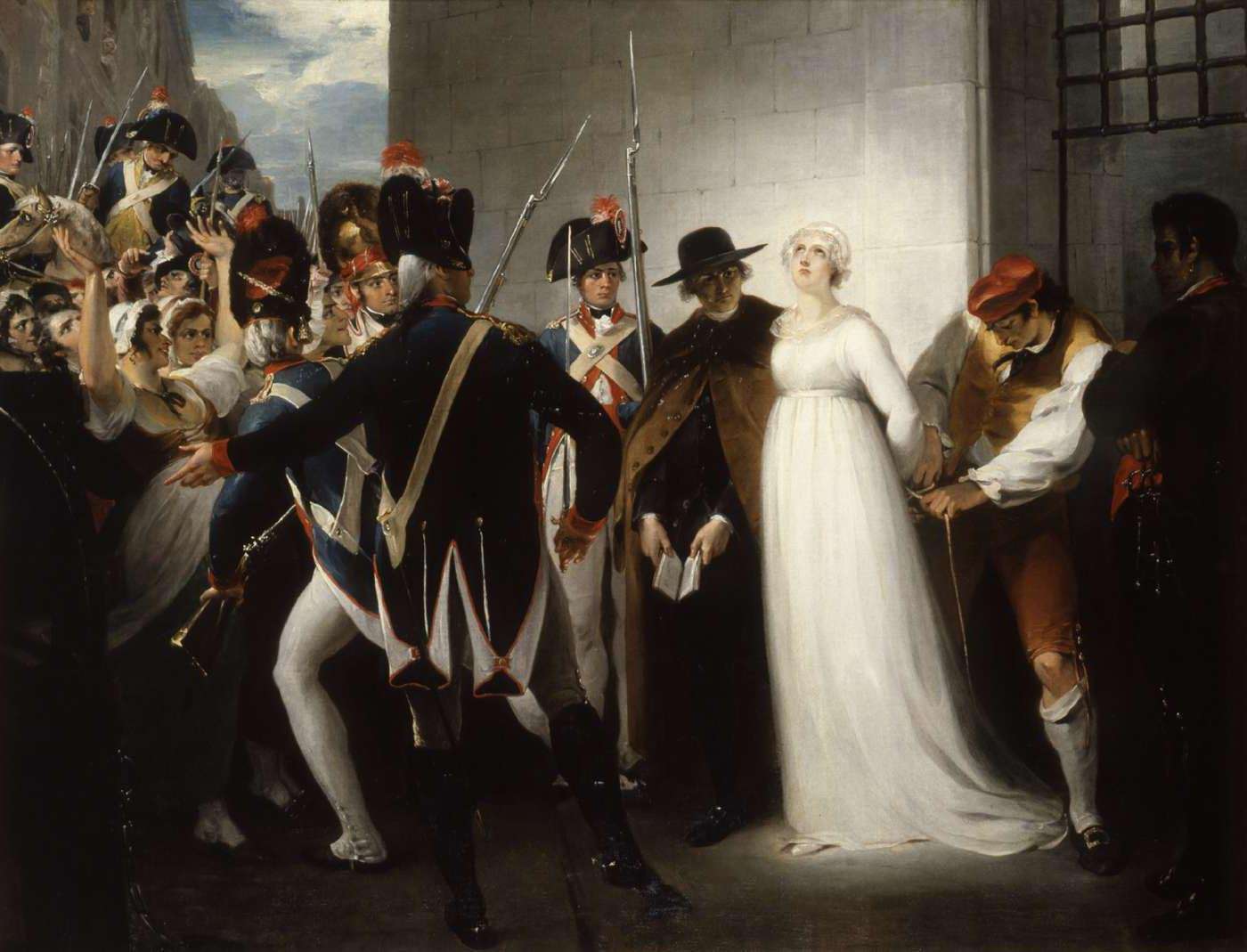
    When she rode to her death on October 16, 1793, many gasped … for Marie Antoinette was just 38, but the crowd saw (as artist David sketched) an old hag in peasant garb, ragged and grey – a stark contrast to the elegant and voluptuous Queen of Trianon, the child of fortune, she had been just 4 years earlier. Marie Antoinette’s hair had been roughly shorn, her hands tied tight behind her back, as she rode in the garbage cart amid the crowd’s whistles and jeers. Yet, the poor woman sat straight and tried to retain her dignity. To the end, Marie Antoinette displayed a queen’s bearing and courage in the face of all adversity.

    After her final ordeal, the body of Marie Antoinette was harshly pushed onto the guillotine plank, her head placed in the vice, and at noon, the blade fell to loud cheers all around. In the words of a revolutionary organ, “Never has Piere Duchesne seen such joy as seeing that [expletive] whore’s head separated from her [expletive] crain’s neck”. Sanson held her bleeding head high for all to see. Later her head was thrown in the cart between her legs. The body of Marie Antoinette was left on the grass before being dumped in an unmarked grave. So ended the life of once the most illustrious and glamorous woman in all Europe.

  • The Diamond Necklace Affair

    How did the French Revolution begin? With the fall of the Bastille. Similarly, how did the American Revolution begin? With shots fired at Lexington and Concord.

    Those are the stock answers, but neither marked the first act of open defiance against the crown. Americans might point to the Boston Tea Party, the Boston Massacre, or the Stamp Act riots. Frenchmen may say the erosion of royal authority that overthrew France’s social order began with the Estates General in 1789 — but before that, the first event to both rock the foundation of the monarchy and display open defiance of royal authority was the “Diamond Necklace Affair,” also known as the “Affair of the Queen’s Necklace.”

    This article retells the story of the Diamond Necklace Affair — one of the most notorious public scandals in history. It involved great fortunes made and lost, avarice, mystery, and intrigue. It pitted great forces in French society against each other, and in the end severely damaged the monarchy, and destroyed for all time the reputation of the second-highest public figure in France. The story begins with three players, the first of whom is that famous public figure: the Queen of France, Marie Antoinette.

    The Queen

    Marie Antoinette en gaulle
    Élisabeth Louise Vigée Le Brun, 1783. Oil on canvas. Private collection (Wolfgarten Castle, Hesse). Public domain, via Wikimedia Commons.

    Marie Antoinette was an Austrian princess when she came to France at age fifteen, in 1770, to marry the Crown Prince. She and her husband Louis XVI were still teenagers when they ascended the throne in 1774. Unlike her shy, awkward husband, Marie Antoinette was admired for her legendary beauty, grace, and elegance, and her tastes set fashion trends across Europe. She took pride in her appearance and in her ancestry as a princess of the House of Habsburg, the oldest royal house in Europe. Her arrogance bred resentment among the old nobility of France — a country that had been at war with Austria for much of the eighteenth century. Marie Antoinette also attracted gossip for her inability to become pregnant (due to Louis’s impotence) and produce an heir to the throne, for her youthful disregard of court etiquette, and for her frivolous and costly lifestyle. This lifestyle included gambling, masked balls, late-night rendezvous, and rumours of numerous love affairs with both men and women. By 1785, an underground literature existed that reviled the Queen in pornographic songs, pictures, and pamphlets.

    Marie Antoinette with a Rose Élisabeth Louise Vigée Le Brun, 1783. Oil on canvas. Palace of Versailles. Public domain, via Wikimedia Commons.

    Much of Marie’s fast-and-loose behaviour in her first decade in France was a reaction to her marital frustration, but in 1778 Louis underwent an operation, and the couple at last had children. By 1785, Marie Antoinette had given birth to three children. She was maturing, and her lifestyle had grown far more settled and less extravagant. But that change was barely noticeable to the uninformed public and did little to appease those who had already developed a deep dislike for her.

    The Nobleman

    Cardinal de Rohan (engraving) C. N. Cochin (del.) / C. P. Campion de Tersan (sculpt.), 18th century. Bibliothèque nationale de France. Public domain, via Wikimedia Commons.

    Against this backdrop, in 1784, enter the two key players in the story: a great nobleman and a woman swindler who dupes him. The nobleman Louis René Édouard de Rohan was a Cardinal of France and a son of one of its oldest and most celebrated noble houses. However, Rohan had a problem — he was out of favour at the French court. The Queen’s mother, Marie Thérèse, had disliked Rohan, a frivolous dandy, during his time as a diplomat in Austria. After her mother scorned him, Marie Antoinette refused to receive Rohan and had not spoken a word to him in years. For a decade, Rohan had longed to become a member of the Queen’s inner circle, with the favour and patronage such access could bring. Rohan, the dandy, was also attracted by the Queen’s beauty and fancied that, if she would only admit him to her circle, he too might partake in the amorous adventures so frequently rumoured at court.

    The Swindler

    Jeanne de Valois-Saint-Rémy, Comtesse de la Motte John Goldar (engraver), after Robint, 1790. Frontispiece to Vie de Jeanne de Saint-Rémy de Valois, London, 1790–91. Bibliothèque nationale de France. Public domain, via Wikimedia Commons.

    The woman swindler is the Countess de Lamotte. She was a daughter of the ancient and illustrious Valois family, though the family had long since lost its resources. She was quite impoverished when she arrived in Paris, but Lamotte was also attractive and brazen in her desire to escape poverty and obtain an aristocratic life of comfort and leisure. She sought to enlist the sympathy of the royal court on behalf of a woman from one of France’s great old houses. Given to fainting spells at court, she at last received notice from Madame Élisabeth, the King’s sister, who provided her with some financial support. She also caught the eye of Cardinal Rohan, and by 1784 had become his mistress. Even though she had not succeeded in obtaining the Queen’s interest or support — and had never even met the Queen — Lamotte managed to convince Cardinal Rohan that she enjoyed Marie Antoinette’s favour. Rohan fully subscribed to the tales circulating in court circles about Marie Antoinette’s dissipation. Using her attractive looks to great effect, Lamotte spun stories that convinced Rohan she was becoming one of the Queen’s new intimate companions — just as Rohan himself hoped to become the Queen’s lover.

    The Necklace

    Le Collier de la reine (reconstitution en zircone, château de Breteuil). Public domain, via Wikimedia Commons.

    Now enters the object that everyone sought: the necklace. It was composed of 2,800 carats of diamonds. First came a choker of seventeen diamonds, each weighing five to eight carats; from that hung a three-wreathed festoon with pendants; then came the necklace proper, a double row of diamonds culminating in an eleven-carat stone; and finally, four knotted diamond tassels. It cost 1,600,000 livres — perhaps the equivalent of $100 million in today’s currency. The jeweller Charles Boehmer had commissioned the magnificent necklace for Madame du Barry. But Louis XV died, du Barry was banished from court, and Boehmer pinned his hopes on the new Queen. She modelled it before her ladies but would not purchase it, nor permit Louis to buy it as a gift for her. “Better to buy a new ship of the line than to spend such a sum on a necklace, however beautiful,” she said.

    The Opportunity

    Boehmer had also seen Lamotte at court. Like Rohan, the jeweller believed the rumours about Marie Antoinette and, impressed by Lamotte’s looks and convinced of her intimacy with the Queen, sought her out as an intermediary. Knowing Rohan’s keen desire to gain the Queen’s favour, Lamotte saw her opportunity: she would trade on both men’s belief in her closeness to the Queen to satisfy their desires — and enrich herself. She told the Cardinal that the Queen wished him to secretly purchase the necklace on her behalf. The Cardinal obtained the necklace from Boehmer and handed it to Madame Lamotte, expecting the Queen to pay for it. Of course, Marie Antoinette never saw the necklace. Lamotte gave the diamonds to her husband, who took them to London and sold them. She also forged letters in the Queen’s name to Rohan, attesting to her interest in the necklace, approving the plan and Lamotte’s role, and hinting that Rohan could expect a return to the Queen’s favour.

    The Rendezvous

    The forged letters satisfied Rohan for a time, but at Versailles, Marie Antoinette continued to ignore him as always. He wanted a real sign of her interest. And so, in the gardens of the Palais Royal in Paris, the final piece of the puzzle fell into place — in the form of a twenty-five-year-old streetwalker named Madame d’Olivia. Buxom and blonde, with an arrogant strut that caused people to call her “the Queen,” d’Olivia bore a striking resemblance to the twenty-nine-year-old Marie Antoinette. Lamotte was immediately captivated. And so, Cardinal Rohan did receive the sign of favour he had longed for — or so he thought. On a summer night in 1784, Lamotte dressed d’Olivia in a lawn gown, identical to the famous “en gaulle” portrait of Marie Antoinette then on exhibit. The veiled woman briefly met the Cardinal in the gardens of Versailles late at night, as Antoinette was rumoured to meet her lovers. The false Queen handed the Cardinal a rose. “All may be forgiven,” she whispered, then hurried away — leaving Rohan utterly convinced he had met Marie Antoinette herself.

    The Confrontation

    Unaware of the drama unfolding around her, Marie Antoinette was busy preparing herself for the role of the saucy barmaid Rosina in the controversial play The Marriage of Figaro. One day, during rehearsals, Boehmer’s invoice for the necklace arrived and was discarded by the Queen. Later, Boehmer came to Versailles and spoke to the Queen’s attendant, Madame Campan, seeking payment. He displayed forged letters bearing the Queen’s signature and explained how Cardinal Rohan had been involved in acquiring the necklace. At last, Marie Antoinette grasped the seriousness of the situation and summoned Boehmer to Versailles. She was furious with Rohan, as was Louis XVI. The royal couple demanded a trial. They arranged for the Cardinal’s arrest — the most public arrest imaginable — having the warrant delivered to him in the great hall of Versailles before hundreds of witnesses. He was brought before the King and Queen, who confronted him with the swindle and refused to hear his protestations of innocence and his claims that he too had been made a fool.

    The Trial

    Marie Antoinette before the Revolutionary Tribunal Alphonse François (engraver), after a painting by Pierre Bouillon, 19th century. Public domain, via Wikimedia Commons.

    The public arrest of the Cardinal of France had already caused a national sensation, and the actions of the King and Queen that followed only added fuel to the fire. That this nobleman — with whom she had not exchanged a single word in fifteen years — should dare to presume she, Marie Antoinette, had met him at a secret rendezvous was a profound insult to her name and reputation. The proud Queen demanded public vindication. The matter could have been handled quietly at court or through the Vatican. Louis’s advisors counselled caution, but the wavering King agreed to a public trial before the Parlement of Paris.

    France in 1785 was unaccustomed to such public spectacles. While rumours of Marie’s errant behaviour had been prevalent in the capital, they now became a sensation across all of France. The charge against the Cardinal was lèse-majesté — an insult to the dignity of the Queen. For months, the nation was gripped by the mystery of the diamond necklace and by the endless recounting of the Queen’s reputation that had led Rohan to believe she had participated. The public was riveted by the cast of characters: the swindler Lamotte, the prostitute who had impersonated the Queen, and a $100 million necklace at stake at a time when the country faced bankruptcy. Throughout it all, Lamotte maintained that the Queen was behind everything and had the necklace.

    The Verdicts

    Defending the Queen’s dignity was never going to be easy. Though she never appeared in court, this case put the life and character of Marie Antoinette on trial. Many jurors could well believe, given her past spending and reputation for a loose lifestyle, that the Queen was capable of such activities, and that the Cardinal had been reasonable in his assumptions. The Cardinal struck a sympathetic figure as he pleaded his devotion to the Queen and insisted he had only sought to serve her. But this was no ordinary court — it was a court of nobles in Paris, where the Rohan family was powerful and wealthy, where many had been at odds with the King, and where even more resented the Queen. Considerable sums were also passed in bribery by the Duc d’Orléans and other disaffected noblemen. The trial ended with the Cardinal acquitted of the charge of lèse-majesté. Lamotte was found guilty of theft and imprisoned. She was also publicly flogged and branded. As she struggled against the branding iron, the poker slipped and pierced her breast. Lamotte hurled imprecations for all to hear: “It is the Queen who should be branded, not me!”

    The Uproar

    On the night of the verdict, against her constable’s advice, Marie Antoinette attended a charitable benefit at the Paris Opera. When the verdict — “Rohan Acquitted” — was announced, the opera house erupted in applause. The crowds then whistled and jeered at the Queen, who departed in dismay and returned to Versailles to weep with her ladies-in-waiting. Repudiation of a French sovereign by court verdict and public rebuke had never before occurred. The Revolution had begun. Within the year, Lamotte escaped to London, where she and her husband enjoyed the proceeds from the sold diamonds. She also took up the pen to spread malicious rumours about Marie Antoinette.

    The Libels

    Lamotte’s pamphlets — filled with new tales of the Queen’s sexual appetites and orgies at Versailles, along with alleged love letters between Rohan and the Queen — became a new sensation in France as they were smuggled in by the thousands. The court literature against Marie Antoinette, which had previously circulated mainly in the capital, had now, by virtue of the necklace case, become commonplace throughout France. The economic position of the country worsened, and King Louis — who had drawn closer to Marie in her sorrows — increasingly turned to her for advice on economic matters. The Queen’s growing role in affairs of state, combined with her national disgrace, weakened the position of Louis and the monarchy. Her very presence galvanised and emboldened the opponents of the regime.

    The Revolution

    Revolution might have been averted in France after the necklace case, just as it might have been averted in America after the Boston Tea Party — but a course of action had been set in motion. The monarchy had been humbled by the noblemen in court and by the people, and all of it had been done with impunity. Going forward, the opponents of the regime — first among the nobles, then later among the merchants, and finally among the peasantry — took heed and did not relent until the final violent overthrow of the French monarchy and the Terror that followed. The nobles who had sought to check Louis’s power, and others like Philippe Égalité who had resented the King, came to be caught up themselves in the whirlwind of Revolution. That Revolution would claim the lives of thousands of noblemen, including Philippe himself, and bring an end to the privileges nobles had enjoyed in France for centuries. This was not what the nobles had intended when they sought to vindicate Rohan and strike a blow against the King and Queen.

    The Reversal

    When Marie Antoinette learned of the necklace affair, she instinctively insisted on a public trial to avenge the offence to her honour and dignity. No one could have imagined how that act of hubris would trigger the catastrophic upheaval of Revolution in the seven years that followed. In 1786, Madame Lamotte was imprisoned and branded; Rohan was acquitted at trial but forced from his Cardinal’s post to a remote appointment. Marie Antoinette sat upon her throne — still the glamorous, powerful Queen of France — meting out punishment to those who dared transgress her honour. In seven years’ time, the Revolution would reverse the positions of all three players in this story. By 1793, Lamotte, who had escaped prison, lived in comfort in England. The fortune she and her husband had gained from the necklace was augmented by the profits from her best-selling pamphlets against the Queen — pamphlets that had made her a hero of the Revolution. By 1793, Rohan too was living in comfortable exile. In the early years of the Revolution he had returned to France in triumph and been elected to the Assembly, but seeing the violent turn of events against the nobility and clergy — including members of his own family — he fled once more to live out the remainder of his life abroad.

    The World Upside Down

    In the ultimate role reversal, the hunter became the prey. The year 1793 saw the final destruction of Marie Antoinette — humbled, humiliated, and at last beheaded by her own subjects. The years of Revolution had taken everything from her: her palaces, her jewels, her servants, her fine clothes, her friends, and her family. Her beauty and finery — in which she had taken such pride — and all the other trappings of her once fabulous life, were gone. In the end, Marie Antoinette was alone. She was taken from her prison cell as a poor, broken widow in rags, aged beyond her years. Now it was she who stood in the dock. She who would have to answer the charges of the Revolutionary Tribunal — including the necklace affair allegations of Madame Lamotte.

    The Queen Beheaded

    Marie Antoinette being taken to her execution, 16 October 1793 William Hamilton, 1794. Engraving. Public domain, via Wikimedia Commons.

    Those charges still rang in her ears amid the jeers of the crowd as Marie Antoinette rode to her appointment with Madame Guillotine. The former Queen now rode in an open cart, her hands tied behind her back, tethered like a chained animal. Lamotte must have relished the irony: seven years after she herself had been flogged, branded, and humiliated, seven years after she had sworn vengeance, it was the turn of her tormentor to face punishment. Marie Antoinette was beheaded at age thirty-seven, her head held high as the populace cheered her death. Such was the pendulum swing of the great French Revolution — first set in motion by the case of the Queen’s necklace.

  • A Reputation in Shreds

    Portrait of Marie-Antoinette, Queen of France in crimson dress holding a book After Élisabeth Louise Vigée Le Brun, 18th century. Oil on canvas. Public domain, via Wikimedia Commons.

    An article by E.M. Vidal

    She is the queen who danced while the people starved; who spent extravagantly on clothes and jewels without a thought for her subjects’ plight. Such is the distorted but widespread view of Marie-Antoinette, Queen of France (1755-1793), wife of King Louis XVI. The recent Coppola film has further damaged the image of the much-maligned, beautiful and charming Austrian archduchess, sent to France at age fourteen to marry the fifteen-year-old Dauphin. Sadly, the picture many people now have of Marie-Antoinette is of her running through Versailles with a glass of champagne in her hand, eating bonbons all day long, and rolling in the bushes with a lover.

    In reality, she was a teetotaler who ate frugally. She was notorious for her intense modesty. Even some prominent biographers, who have insisted upon the possibility of an affair with Swedish Count Axel von Fersen, have had to admit that there is no solid evidence. Yes, she had a gambling problem when young. She loved to entertain and had wonderful parties. She liked to dance the night away, but settled down when the children started to come. She had a lively sense of humor. Her clothes, yes, were magnificent; volumes could and have been written about Marie-Antoinette’s style. She did gradually introduce simpler fashions to France, however.

    It is known that Queen Marie-Antoinette had high moral standards. She did not permit uncouth or off-color remarks in her presence. She exercised a special vigilance over anyone in her care, especially the young ladies of her household. As Madame Campan relates in her Memoirs:

    All who were acquainted with the Queen’s private qualities knew that she equally deserved attachment and esteem. Kind and patient to excess in her relations with her household, she indulgently considered all around her, and interested herself in their fortunes and in their pleasures. She had, among her women, young girls from the Maison de St. Cyr, all well born; the Queen forbade them the play when the performances were not suitable; sometimes, when old plays were to be represented, if she found she could not with certainty trust to her memory, she would take the trouble to read them in the morning, to enable her to decide whether the girls should or should not go to see them,—rightly considering herself bound to watch over their morals and conduct.

    Marie Antoinette and her Children (1787) by Élisabeth Louise Vigée Le Brun. Palace of Versailles. Public domain, via Wikimedia Commons.

    In pre-revolutionary France it was for the King and the Queen to give an example of almsgiving. Louis XVI and Marie-Antoinette took this duty seriously and throughout their reign did what they could to help the needy. During the fireworks celebrating the marriage of the young prince and princess in May 1770, there was a stampede in which many people were killed. Louis and Marie-Antoinette gave all of their private spending money for a year to relieve the suffering of the victims and their families. They became very popular with the common people as a result, which was reflected in the adulation with which they were received when the Dauphin took his wife to Paris on her first “official” visit in June 1773. Marie-Antoinette’s reputation for sweetness and mercy became even more entrenched in 1774, when as the new Queen she asked that the people be relieved of a tax called “The Queen’s belt,” customary at the beginning of each reign. “Belts are no longer worn,” she quipped. It was the onslaught of revolutionary propaganda that would eventually destroy her reputation.

    Portrait of Louis XVI Antoine-François Callet, 1779. Oil on canvas. Palace of Versailles. Public domain, via Wikimedia Commons.

    The King and Queen were patrons of the Maison Philanthropique, a society which helped the aged, blind and widows. The queen taught her daughter Madame Royale to wait upon peasant children, to sacrifice her Christmas gifts so as to buy fuel and blankets for the destitute, and to bring baskets of food to the sick. Marie-Antoinette started a home for unwed mothers at the royal palace. She adopted three poor children to be raised with her own, as well overseeing the upbringing of several needy children, whose education she paid for, while caring for their families. She brought several peasant families to live on her farm at Trianon, building cottages for them. There was food for the hungry distributed every day at Versailles, at the King’s command.

    During the famine of 1787-88, the royal family sold much of their flatware to buy grain for the people, and themselves ate the cheap barley bread in order to be able to give more to the hungry. There were many other things they did; what I mentioned here is taken from Vincent Cronin’s Louis and Antoinette, as well as Marguerite Jallut’s and Philippe Huisman’s biography of the Marie-Antoinette. The royal couple’s almsgiving stopped only with their incarceration in the Temple in August 1792, for then they had nothing left to give but their lives.

    Here is an excerpt from Charles Duke Yonge’s biography of Marie-Antoinette, describing how the queen tried to reform the morals of the court.

    Her first desire was to purify the court where licentiousness in either sex had long been the surest road to royal favor. She began by making a regulation, that she would receive no lady who was separated from her husband; and she abolished a senseless and inexplicable rule of etiquette which had hitherto prohibited the queen and princesses from dining or supping in company with their husbands. Such an exclusion from the king’s table of those who were its most natural and becoming ornaments had notoriously facilitated and augmented the disorders of the last reign; and it was obvious that its maintenance must at least have a tendency to lead to a repetition of the old irregularities. Fortunately, the king was as little inclined to approve of it as the queen. All his tastes were domestic, and he gladly assented to her proposal to abolish the custom. Throughout the reign, at all ordinary meals, at his suppers when he came in late from hunting, when he had perhaps invited some of his fellow-sportsmen to share his repast, and at State banquets, Marie Antoinette took her seat at his side, not only adding grace and liveliness to the entertainment, but effectually preventing license, and even the suspicion of scandal; and, as she desired that her household as well as her family should set an example of regularity and propriety to the nation, she exercised a careful superintendence over the behavior of those who had hitherto been among the least-considered members of the royal establishment.

    Too often in the many articles about Marie-Antoinette that have surfaced in the last year due to the Coppola film, Count Axel von Fersen is referred to as the “queen’s lover” or as her “probable lover.” It is repeatedly disregarded that there is not a scrap of reliable historical evidence that Count Fersen and Marie-Antoinette were anything but friends, and that he was as much her husband’s friend as he was hers. People are free to speak of Louis XV and Madame de Pompadour as “lovers” since they openly lived together for many years. But to speak that way of Marie-Antoinette, who lost her life because she chose to stay at her husband’s side, is the height of irresponsibility.

    Portrait of Count Hans Axel von Fersen Lorenz Pasch the Younger, 18th century. Oil on canvas. Public domain, via Wikimedia Commons.

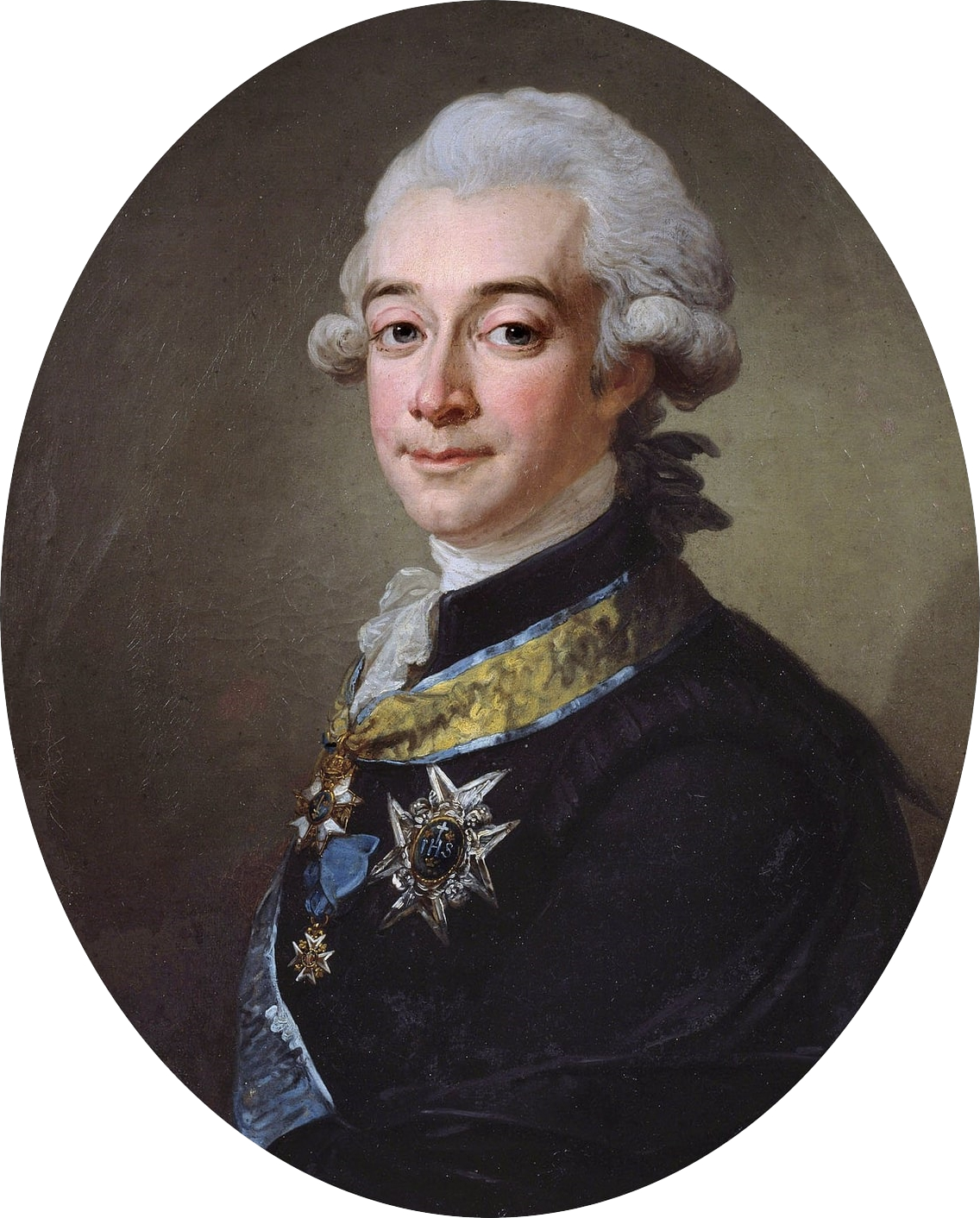
    The Swedish nobleman was in the service of his sovereign King Gustavus III and Count Fersen’s presence at the French court needs to be seen in the light of that capacity. The Swedish King was a devoted friend of Louis XVI and Marie-Antoinette and Gustavus, even more than the queen’s Austrian relatives, worked to aid the King and Queen of France in their time of trouble. Fersen was the go-between in the various secret plans to help Louis XVI regain control of his kingdom and escape from the clutches of his political enemies. The diplomatic intrigues that went on behind the scenes are more interesting than any imaginary romance. (The queen’s relationship with her husband is more interesting as well.) However, books and movies continue to add this sensationalism to the queen’s life, as if anything could be more sensational than the reality. Serious modern and contemporary scholars, however, such as Paul and Pierrette Girault de Coursac, Hilaire Belloc, Nesta Webster, Simone Bertière, Philippe Delorme, Jean Chalon, Desmond Seward, and Simon Schama are unanimous in saying that there is no conclusive evidence to prove that Marie-Antoinette violated her marriage vows by dallying with Count Fersen.

    Portrait of Madame Campan Julie Duvidal de Montferrier, early 19th century. Oil on canvas. Palace of Versailles. Public domain, via Wikimedia Commons.

    As Jean Chalon points out in his biography Chère Marie-Antoinette, Fersen, who had many mistresses, saw the queen as an angel, to whom he offered reverent and chaste homage. According to Chalon, Marie-Antoinette knew about sex only through conjugal love, where she found her “happiness,” her bonheur essentiel, as she wrote to her mother. If there had been any cause for concern about Count Fersen’s presence at the French court as regards the queen’s reputation, the Austrian ambassador Count Mercy-Argenteau would surely have mentioned it in one of the reams of letters to Marie-Antoinette’s mother Empress Maria Teresa, to whom he passed on every detail of the young queen’s life. Count Mercy had spies whom he paid well to gather information, but Fersen was not worth mentioning. Neither is he mentioned in a romantic way by other people close to the queen in their memoirs, such as her maid Madame Campan. Madame Campan herself refuted any calumnies in her Memoirs when she said of Marie-Antoinette:

    I who for fifteen years saw her attached to her august consort and her children, kind to her servitors, unfortunately too polite, too simple, too much on an equality with the people of the Court, I cannot bear to see her character reviled. I wish I had a hundred mouths, I wish I had wings and could inspire the same confidence in the truth which is so readily accorded to lies.

    The accounts of those whose personal knowledge of the queen, or deep study of her life, reveal her virtue, as well as her fidelity and devotion to her husband, are continually ignored. Montjoie in his Histoire de Marie-Antoinette, Vol.i, p.107 (1797) quotes the words of her page, the Comte d’Hézècques:

    If one wishes to discover the prime cause of the misfortunes of this princess, we must seek them in the passions of which the court was the hotbed and in the corruption of her century. If I had seen otherwise I would say so with sincerity, but I affirm that after having seen everything, heard everything, and read everything, I am convinced that the morals of Marie Antoinette were as pure as those of her virtuous husband.

    But since so often the testimonials of French monarchists are seen as being an attempt to ingratiate themselves to the surviving Bourbons, here is what the Irish politician and author John Wilson Croker (1780-1857) wrote in his Essays on the French Revolution:

    We have followed the history of Marie Antoinette with the greatest diligence and scrupulosity. We have lived in those times. We have talked with some of her friends and some of her enemies; we have read, certainly not all, but hundreds of the libels written against her; and we have, in short, examined her life with– if we may be allowed to say so of ourselves– something of the accuracy of contemporaries, the diligence of inquirers, and the impartiality of historians, all combined; and we feel it our duty to declare, in as a solemn a manner as literature admits of, our well-matured opinion that every reproach against the morals of the queen was a gross calumny– that she was, as we have said, one of the purest of human beings. (Croker’s Essays, p 562)

    It is an assessment with which I fully agree. I hope that in the future responsible scholarship about Queen Marie-Antoinette and her family comes to replace lies which have fed the popular imagination for long.

    All rights are reserved by EM Vidal © 2007-2008

    First published at Tea at Trianon, October 26, 2007.